
« More Labr@ng Photos | HOME PAGE | Sounds of Xinjiang »
March 18, 2008
Right & Wrong
PHOTOS Those of you looking for evidence of violence against the protesters should take a look at this gallery. Photos are very graphic. Flash and an uncensored connection required.
••••
One question that I haven't heard asked or answered much in Western news media over the past few days: were the actions of the rioters in Lh@sa justified?
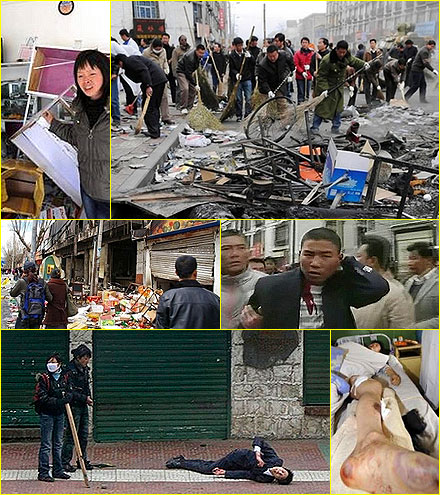
One thing that's become quite clear is that the protests in Lh@sa devolved quickly into an all-out riot — complete with lynchings — while in other places monks seem to have marched more or less peacefully. (At least according to what we know now, which is very little.) Even if half the stuff written in the Chinese media about what Tibetans in Lh@sa did to local Han and Hui residents is true, I'm gonna have to step out on a limb here and say that it's just plain wrong.
From Xinhua:
In the Lh@sa unrest, rioters sliced off people's ears, gored children, clubbed young Tibetans into coma and tried to block nurses from saving an injured 5-year-old.
Tibet regional chairman Qiangba Puncog told a news briefing in Beijing on Monday that 13 innocent civilians were burned or stabbed to death in Friday's riots.
Puncog said that the mobs' actions were extremely brutal. "In one incident, they poured gasoline onto an innocent person and burned the person to death. In another, they knocked over a police officer, and then knifed a fist-size piece of flesh out of the officer's buttocks."
From China Daily:
Some rioters wielded iron rods, wooden sticks and long knives, randomly assaulting passersby, sparing neither women nor children....
Tubdain, a local resident, said he saw a girl in red-clothing who appeared to be an ethnic Han chased and clubbed by six people on the Dosenge Road in the downtown area. "The mobs stoned her head and batted her knees with wooden clubs," said the 50-something Tubdain.
"Blood trickled down her face. She stumbled to the ground, crying and begging the rioters to let her go," he said. "They seemed like a bunch of insane people, growling, stabbing, smashing and burning. It was so hard to believe what I saw."
Jin Hong, a clerk with the Bank of China outlet on Lh@sa's Beijing East Road, suffered a broken pelvis after jumping from the second-floor of the building while trying to protect a cash box.
"About 60 rioters, all young men and women, attacked the bank with rocks and axes and set fire to the building on Friday afternoon."
"I hid in the toilet with three colleagues, but the mobs thronged against the toilet door. I had to jump out of the window," she said.
Now, I know many of you will argue that the explosive anger shown in the riots is a result of years of boneheaded Chinese policy in Tibet and an extremely repressive environment. You're right. And some of you will say, well, there are probably 100 or more Tibetans dead. Maybe. But does that give people the right to cut chunks out of other people's butts? Aren't Tibetans supposed to take the high road, like Gandhi, Dr. Martin Luther King Jr., and... err, Jesus? (How did these three ever come to form a trio in my mind? I'm a Jew for Christ's sake!)
I'm sure Richard Gere and the Beastie Boys didn't fall in love with Tibet for its ancient doctrine of violence and destruction.
Yes, the Chinese have pushed the Tibetan people for years and years, and something's gotta give. Nevertheless, the shameful actions of the rioters in Lh@sa targeting innocent civilians last week should be condemned. Right is right, and wrong is still wrong.
Tibetan religious leaders, specialists condemn violence in Lh@sa
17 March 2008
Xinhua News Agency
(c) Copyright 2008 Xinhua News Agency
Lh@sa, March 17 (Xinhua) -- Tibetologists in Lh@sa have condemned the violence that rocked the Buddhist holy city and killed 13 innocent people Friday.
Cering Doje, deputy director of the religion research institute of the Tibetan Academy of Social Sciences (TASS), said that he questioned the Dalai Lama's humanity and mercy.
"Religion advocates care and mercy, but the reckless rioters attacked hospitals and child-entertainment centers," Doje said, "They seemed to have lost basic humanity, and there was no mercy at all."
Other Tibetologists said that they were outraged by the Dalai Lama's silence in condemning the riot.
In the Lh@sa unrest, rioters sliced off people's ears, gored children, clubbed young Tibetans into coma and tried to block nurses from saving an injured 5-year-old.
Tibet regional chairman Qiangba Puncog told a news briefing in Beijing on Monday that 13 innocent civilians were burned or stabbed to death in Friday's riots.
Puncog said that the mobs' actions were extremely brutal. "In one incident, they poured gasoline onto an innocent person and burned the person to death. In another, they knocked over a police officer, and then knifed a fist-size piece of flesh out of the officer's buttocks."
On Saturday, the Dalai Lama charged that Tibet was being ruled by terror, which Tibetan officials rejected as "downright nonsense".
Basang Wangdu, another Tibetologist and a council member of the International Society of Tibetology, said that people could see from Friday's riots that the Dalai Lama had not ceased his secessionist activity but added that these attempts "will not succeed."
While condemning the riots, others called for solidarity among all ethnic groups at what they said was a critical time.
"Tibetans and Hans share a common cultural background. We have links that cannot be severed," said Cering Gyaibo, the head of TASS' religion research institute.
"At this critical time, we need to cherish ethnic solidarity and muster courage to protect territorial integrity and ethnic harmony," he said.
The religious researchers' comments came as the latest condemnations against the violence. The 11th Panchen Lama, Gyaincain Norbu, said on Sunday that the violence in Lh@sa ran counter to Buddhism tenets.
Living Buddhas in Tibet also voiced their opposition. Ngawang Daindzin, a living Buddha, said that "the rioters who wore cassocks were no real monks at all. What they did is completely against Buddhism codes."
Local Tibetans, who survived the violence, said they were deeply hurt. A retired worker, Cering Yangzom, said that "it had been repeatedly proven that the Dalai Lama and his followers could not separate Tibet from China, and such savage acts only hurt the feelings of many Tibetans and only revealed a true picture of the Dalai Lama."
Fears and tears in holy plateau city
China Daily
Updated: 2008-03-17 06:36
Lh@sa - Dense smoke blanketed the sky as burning cars emitted an irritating smell amid the wailing of bloodshed.
A Tibetan teacher said she couldn't believe her eyes.
"I've never seen such cruelty before. How can anyone do something like this?" asked Zhayung, who works at the No 1 primary school in Lh@sa. Her voice was still shaky and her complexion tinged with fear and sheer shock.
The school she worked at was among a range of targets damaged by saboteurs in the Tibetan capital on Friday afternoon.
Vandals carrying backpacks filled with stones and bottles of inflammable liquids smashed windows, set fire to vehicles, shops and restaurants along their destructive path.
Some rioters wielded iron rods, wooden sticks and long knives, randomly assaulting passersby, sparing neither women nor children.
"Classes were cancelled," Zhayung said. "I managed to escape from the school and hide in the building across the street, but some of my colleagues were stranded in the school for the whole night until police came to their rescue."
For many Lh@sa residents such as Zhayung, March 14 stopped being just another Friday - it was a day when the capital was left in chaos after an outburst of beatings, vandalism, looting and burning, which officials say was "masterminded by the Dalai clique".
The Tibet regional government said on Saturday at least 10 people were killed, including several from burns and gunshot wounds. Police managed to rescue more than 580 people, including three Japanese tourists, from attacks.
Sources told Xinhua that rioters had ransacked at least 100 shops. The four-storey Landun shopping mall in the old city center, which sold children clothes, was engulfed in flames sparked by the horde.
Its owner, Ye Danping, and her 20 Tibetan employees were lucky to survive after scrambling onto the roof of the building.
Nightmares
As tensions began to ease on Saturday, residents in the traditionally tranquil plateau city recalled the nightmares they went through.
Rawang, a Tibetan clothes vendor in downtown Lh@sa, sighed at the dreary scene, once the site of bustling commerce. "It was once a shopping haven, but now it's all deserted, like a hell." His shop was burnt to the ground. "Losses were grave. These people were crazy," he said.
Tubdain, a local resident, said he saw a girl in red-clothing who appeared to be an ethnic Han chased and clubbed by six people on the Dosenge Road in the downtown area. "The mobs stoned her head and batted her knees with wooden clubs," said the 50-something Tubdain.
"Blood trickled down her face. She stumbled to the ground, crying and begging the rioters to let her go," he said. "They seemed like a bunch of insane people, growling, stabbing, smashing and burning. It was so hard to believe what I saw."
Jin Hong, a clerk with the Bank of China outlet on Lh@sa's Beijing East Road, suffered a broken pelvis after jumping from the second-floor of the building while trying to protect a cash box.
"About 60 rioters, all young men and women, attacked the bank with rocks and axes and set fire to the building on Friday afternoon.
"I hid in the toilet with three colleagues, but the mobs thronged against the toilet door. I had to jump out of the window," she said.
Saved by Tibetan folks
In response the regional government imposed traffic bans and increased the police presence to ensure social security.
For the many ethnic Hans who were lucky enough to survive the disaster, they said it was the Tibetan folks who saved them.
Sun Pingjiang, an ethnic Han and owner of a Titan-styled accessories store near the R@mogia monastery, said he owed his life to an elderly Tibetan woman who saved him from bleeding to death.
"I was attacked by more than 30 people about my age when I was running from my store to my friend's. The mobs beat and stabbed me," said the 26-year-old.
"When I finally managed to run away, I stumbled along and knocked at every door I could for help. A Tibetan woman in a chessboard game room came to my rescue," he said. "She took me in and called the emergency number 120 when the streets calmed down," he said.
Sun is being treated for leg and back injuries at the General Hospital of Tibet Military Command.
During Friday's riot, many local Tibetans came to the help of ethnic Hans.
Ma Ruixia, a Han woman who owns clothes and souvenir shops on Barkor Street in the downtown, said her establishments were attacked twice by the mob. She survived with the help of her Tibetan landlord and neighbors.
"Around 2 pm, Friday, I heard people shouting in the yard that rioters were coming and we needed to take shelter," she recalled.
"My Tibetan neighbors faced up to the mob and pleaded with them not to ravage my stores," she said. "I really didn't know what was going on out there. It was horrible."
Ye, who came to Lh@sa 15 years ago from coastal Zhejiang province, said she would stay on in Lh@sa, because she took this place as her second hometown.
"I wish the government would properly handle the incident and make Lh@sa a safe place again," she said.

posted March 18, 2008 at 07:42 AM unofficial Xinjiang time | HaoHao This!
Comments
Our goverment give Tibiant Super-national treatment.
If a Tibiant and a Han Chinese bustup in school, the Han Chinese will be dismissed out of school.
We give them too many special treatment.
our gov is so mercy that We Han Chinese be afflicted by minorities.
my gov, please use GUN to treat them, these ungrateful person.
The comment above was posted by dyn at March 18, 2008 08:39 AM unofficial Xinjiang time.
@dyn: You're not really helping your side with comments like that.
The comment above was posted by michael at March 18, 2008 08:43 AM unofficial Xinjiang time.
michael, thank you. You are friend of all chinese people. I respect you and your advice.
But I MUST express my thought just as the splittist express their's on your blog.
although Han Chinese is the major nation in China, but our voice are always too low to be heared in all conflicts between nation.
Do NOT equate CCP with Chinese People, if our gov can not hold XiZang, we will overthrow it and establish a new one capable to do that.
The comment above was posted by dyn at March 18, 2008 08:58 AM unofficial Xinjiang time.
Although the western media hasn't dwelt too much on what Tibetans have been doing to the Han Chinese, I have been seeing some references to in in blogs. Just finished viewing a Youtube video that I half suspect was not crafted by just one individual on their own. Nevertheless, they do express the point that Michael does here - both sides are making a mess of this.
The comment above was posted by WoodenboatGuy at March 18, 2008 10:27 AM unofficial Xinjiang time.
Well, the Chinese media has done a good job of defining these protests, and they did so right away. The problem is that they didn't ring true to media outside of China. The early claims where that 10 Chinese Han died and that no shots were fired. They still don't want to admit that Tibetans died. For a long time, the media in the West has been going with the figures that the Chinese government has given, and not the possible 300 hundred dead Tibetans that some sources have given (those that I'm sure are blacked out in China).
There have been hundreds of reports of gunfire and several reports that trucks plowed into protesters, so I don't think we can draw the conclusion that the Tibetans lined up with knives ready for blood. That account seems a little sensational.
Did the Tibetans take things further than the moderates in exile would have liked? Yes they did. However, I think the outside media realizes that these actions are sort of the norm of people put into such a situation. When people are powerless, they take it out on the only signs of Chinese rule they can have an effect on (mostly shops and banks that represent the settlement of the area by larger numbers of Han Chinese).
There is still some hope that the Chinese government will turn to the moderates (like the Dalia Lama) who haven't called for complete independence for years (no matter what China says). When you want out of a situation, you turn to those who, to you, seem less extreme. The out is always there, but some people in power would rather marginalize and divide.
Though I hope these sort of posts don't cause problems for the blog owner.
The comment above was posted by ChrisM at March 18, 2008 11:02 AM unofficial Xinjiang time.
I have to respond to the suggestion that the rioters were monks. It was reported at least 8 hours before the riots that the major monastaries were locked down--were surrounded (indeed there were not enough police in the city's center). While some beatings and resistance went on in the monastaries, the riot was perpetuated by laypersons.
The comment above was posted by ChrisM at March 18, 2008 11:07 AM unofficial Xinjiang time.
饱暖思暴乱are people without a respectable civilization background (European, Indian, Huaxia among the few). I suddenly understand the rationality behind the social structure of pre-liberation Tibet which holds the key of keeping itself stable and sustainable. Friction is between major civilizations and clash between civilization and barbarism.
The comment above was posted by chengduboy at March 18, 2008 12:31 PM unofficial Xinjiang time.
Ugyhur terrorists and Tibet@n splittists always say: "驱回灭汉(drive out Hui Chinese, die out Han Chinese)".
Slaughter are aimed at Chinese People not CCP.
The comment above was posted by dyn at March 18, 2008 12:38 PM unofficial Xinjiang time.
The comments from a major Chinese website(sohu) will show you the angry of Chinese people.
http://comment2.news.sohu.com/viewcomments.action?id=255761149
The comment above was posted by dyn at March 18, 2008 01:02 PM unofficial Xinjiang time.
This riot is carefully planned. First the monks draw out the police forces to create a security voil in the city. Then mobs seized chances with prepared the iron bars, long knife and stones, petrols already in backpack and started to attack shops. Meanwhile all Tibetan owners are noticed beforehand so they can put a scarf out to identify their shops.
But I don't think Dalai Lama promoted this. Instead the Tibet Youth Congress probably the main driver for violence. Time for China to pressure India to kick those bastards out or put those fuckers in wanted list and let India security to handle in. Otherwise, we can promote Assam insurgence by giving them training bases and weapons.
But I still think we need to improve our jobs to prevent this kind of things happen again.
Here is my take on why this is happen:
1. Demography. At 1980 when China started her economic miracle, the economy condition improved for ordinary people, so the birth rate increased with that living improvement. But the country also enforced family planning policy--the so-called one child policy to limit the population growth. This policy is not apply to Tibet. So we have a big growth rate of population with average rate of 6 children per family in Tibetan population. That makes the average age of Tibetan at 21. As we know that will be a big factor on social unrest. For example, America has the same average 21 in 1960s, and China in 1970s. Even without the independent movement, it will be a tough issue to handle.
2. The Tibetan government did a poor job on supplying a good education for those new kids. When the government tried to push for Mandarin and English teaching, it was attacked mercilessly by Western human right groups and exile groups as "culture genocide". So Tibetan government is kind of half-hearted to push for schooling which resulting the lack of education and job skill when job opening is up. As everyone understand that if you speak Tibetan, Mandarin and English will promise you high paying job, and if you only speak Tibetan, then probably the job is not as good as you speak more language. So this factor alone will contribute local Tibetan youth feel that they didn't get the best of economic benefit in their own land. And they alway have a chance to become a monk instead of studying hard.
3. Other high wage jobs like a tour guide for foreign tourists should all go to local Tibetans who can speak English. But here the exile group are doing the damage to prevent it. They would get their people to get the jobs (with their English speaking ability by born in India), then in front of Westerners to show "Free Tibet" banner to make a new event. Then the local government will come to question the tour agency. Even it proved the agency innocent, it may already lose some of business due to the process. So for those tour agencies, even owned by ethnic Tibetans, tend to find out Han Chinese who can speak Tibetans and English as tour guide to avoid get in troubles. Now you can see how Tibetans frustration build up because all good jobs are not for them.
4. Chinese merchants and especially Hui merchants have some to blame too. They should hire more local Tibetans, but due to some culture differences--some of look down on Tibetans, they tend not give patient times to teach their Tibetan employees, but rather to hire some of Han and Hui migrant workers to save the efforts and money.
5. Local security and police are little bit too sensitive sometimes. In other area, like Kham of Sichuan, you can have a Tibetan flag and Dalai Lama picture in the home and temple without bothered by police. Also Tibetan students in Beijing can have Dalai Lama's picture without much trouble. There are some Tibetans who love to be part of China complained that Lhasa is too much a police state and Beijing is a free world.
6. Local police forces (100% ethnic Tibetans) need to make changes too. Their attitude--"Don't accuse Han to oppress you, I am Tibetan, and I will beat you up, so what." may need to give way.
7. Tibet is developed too fast. With such tremendous changes in this few years, people may feel lost of the comfortable zone. The traditional Tibetan culture does feel threatened by the influence of changes. Of course, even the most conservative monks will pick up cell phone and Internet very soon, but there are some of need to address people's confusing and they are need to promote the study of how to evolve the culture.
For all those concerns, I think China needs to do more than today's policy. I would like to see following things happen:
1. Limit the Han and Hui migrant workers that in direct competition of local Tibetans. Promoting co-ownership in business between Han/Hui with Tibetans by preference of banking loan.
2. Supply financial and teaching resources for job training on local Tibetans for enough skill on the job market.
3. Promote Tibetan products--culture and craft in whole China by creating jobs in coast China that Tibetans can have.
In other front, talk with India to drive Tibet Youth Congress out of India. Then at a right time, resume the talk with Dalai Lama.
My suggestion can use in Xinjiang too.
The comment above was posted by sha at March 18, 2008 01:21 PM unofficial Xinjiang time.
DYN,
Read the report. Many Hans are save by Tibetans. Don't use your anger against Tibetans, but those rioters. Every ethnic group has bad apples.
The comment above was posted by sha at March 18, 2008 01:32 PM unofficial Xinjiang time.
to sha:
You are almost right, but
"Limit the Han and Hui migrant workers that in direct competition of local Tibetans." is absolutely a BAD idea.
The only method to insure the peace of Tibet or XinJiang is to make the population of Han Chinese overwhelm that of the minorities in these provinces.
The comment above was posted by dyn at March 18, 2008 01:44 PM unofficial Xinjiang time.
dyn,
You are wrong. Both Tibet and Xinjiang have an average 21 population. That is a very volatile factor. We need to create economic development that local people can enjoy. Otherwise, you marginalize the minority group and make them 2nd rate citizen in their own homeland. That is not the way it supposed to be.
It is not just about minority. It is local policy. For example, if you have big unemployment in Beijing for residents, you cannot import labors from Shanghai to take all those jobs Beijing folks deserve. That is local politics.
You think about to overflow the areas with Han showed that you only trust Han for insure the peace. Do you believe if we don't have majority support of Uighur and Tibetan, we probably will not in this kind of small conflict but rather a huge one? Why we need to punish our own brothers--Uighurs and Tibetans for peace?
The true peace is for all of us to leave a good life which includes to ensure good jobs for our local folks. I even hope one day CCP can open the party to people who have religious believe. The party should be more resemble old offical-scholar class in China. It is for professional administation and not for ideology. So a Christian, a Catholic, a Jew (you, Michael), a Lama, an Iman, etc. can have party membership too.
The comment above was posted by sha at March 18, 2008 01:56 PM unofficial Xinjiang time.
Sha,
For good PR, we should simply silence dyn. But the man, even though foolish enough to speak aloud what his heart truly believes, has a point. Even though your kumbaya version of world is admirable.
First let's admit that we have a problem. If you haven't read
"Peter Hessler piece, I highly recommend you do so.
Our current policy in Tibet is not working! now let's get down to the business of finding a solution.
Let's look at what would serve Chinese national interest best. I wouldn't leave anything off the table including quitting Tibet.
How is Chinese national interest being served by holding on to Tibet?(Don't give me any bullshit about sacredness of territory, those are fairy tales for children.) Let's proceed with our cost/benefit analysis.
Pro:
A. It offers strategic depth, aka a huge natural buffer in the form of Tibetan plateau circled by Himalayan range. Given the longest ranged missles that India has currently in her arsenal, she would have to move the missle silos to Assam border with Tibet to even hope of them landing anywhere with economic significance greater than grass and yak dungs. (okay, Lhasa and Shigatse is in Indian missle range, big deal)
B. Potential resources like mineral deposits. Recent exploration has found huge copper and coal deposit in Mongolia, so why not Tibet.
Con:
A. Economic drain. According to Hessler, "in 1996 China spent some $600 million in Tibet....for that same year the United States gave a total of $800 million dollars in aid to all of Africa"
There is no hope for China ever to recover these "investments" unless large deposit of metal or oil can be discovered AND recovered from Tibet.
B.Resentment from local groups (read monks) that are not benefiting from Chinese rule.
C.Dent to China's international relation/reputation. Let's face it. Dalai boys ran a tighter PR campaign than our ministry of propaganda.
At surface, it seem would be relatively easy for China to pull out of TAR (Tibet Autonomous Region) be done with it. We would still have plenty of buffer in Qinghai and Tibetan area of Sichuan. We can always to pull our weights to make sure Tibet not get too cosy with India and US (carrots=aid and stick=threat of reinvasion) that it be use for staging ground for any anti-China activity.
But would Tibetan be satisfied with just TAR? The position of so-called Tibetan government in exile is that "Tibet" includes all area of Tibetan population (includes Qinghai, Western Sichuan, Northern Yunnan and part of Gansu) even though Dalai lama never controlled these other areas at time of Tibet liberation.
Looked at big protest at Labrang monastery in Xiahe, Gansu right now. Would these monks be satisfied of left out of a Dalai controled Tibet?
While pulling out of TAR would be easy, to separate out administratively these other Tibetan area from their respective provinces would be a nightmare. Plus the fact that many these area hold mixed population of Tibetan,Han and Hui would just add to the trouble.
Let's look at downside of keeping Tibet in China.
A. Economic burden: it's expensive to foot the bill of Tibetan government budget plus the infrastructure development that will be never repaid economically AND the cost of military presence.
Let's assume everything come to $1 billion a year.
Well compare that to the money we have wasted investing in American financial industry (Blackstone, we paid $1 billion to aquire stake in Bear Stern last year etc, Don't even get me started on our increasingly worthless piles of American dollars and treasury bonds), this is chump change. China could simply afford to throw away $1 billion at Tibet every year.
B.Resentment of Tibetans undermined by Chinese control (read monks) We will get to this later
C.China's international reputation. Please, even without Tibet, West will find fault with China. Before Lhasa riot, we are being blame for everything from encourage Darfur genocide to suppression of monks in Burma.
Look at experience of Russia. Even after Russia discarded the Soviet system, Western media paints a very negative picture about Putin's government. Why? Because Putin is no western lapdog and Russia continue to have divergent interest from the West.
We give too much credit to these western wanker hacks if we think their opinion worth that much in the bigger scheme of things.
Ironically, We have much to learn from America. America under George Bush has really push unilateralism (i.e, US will do as US please). As much as anti-American feeling swell in the world, anybody recalling groups advocate IOC to deny Olympics to Chicago because of Iraq?
We just have to build up our power now so that one day clueless Chinese youth will start demanding changes in other countries' behavior and they would have to listen! Meanwhile f*ck uninformed opinion of the West and let's do what's in our interest, okay?
So my crude cost/benefit analysis show that China has very little incentive to let Tibet become independent.
Now let's figure out how to better integrate Tibet into China. Monks will always create trouble for Chinese rule because their self interest as former ruling class of Tibet is being undermined by Chinese control. They have the least to gain under China yet most to profit when Chinese leave.
Let's model ourselves after success. The most successful integration of new territory in recent history is American conquest of the American West. I say without irony or sarcasm that we have much to learn from American success.
Capitalism, private ownership and enlightened self-interest will be a powerful force that forever change the face of Tibet (i mean literally, after witnessing the ugly race riot targeting Han Chinese, specifically Sichuanese, my people, this will be a sweet revenge).
I propose that we legalize outright land ownership. Currently all land belongs to the Chinese State. We can start auction off "public
land" in Tibet to any enterprising Han Chinese (I prefer that Tibetans will be excluded from the auction, but to give outward appearance of not be a completely racist operation, we could include everyone but provide generous state loans to Han Chinese wanting to bid). We give special allowance to Hans in Tibet to bear arms to defend their property.
Essentially any Han Chinese wishing to own land will be given the opportunity and financial incentive to do so in Tibet. Just like American cowboys displace Indians and Aussie ranchers displace aborigines, we will see Han ranchers and farmers taking over in Tibet. This will open the flood gate of Han migration into Tibet. This will escalate the conflict but by allowing new Han landowner to own arms to protect their new properties, the numbers will take care the problem. People will fight tooth and nails for their properties.
Oh yeah, monks could have complete religious freedom. Just no more state subsidies. They could be supported by donations by local Tibetans but no oversea fundings allowed. Impoverished Tibetan lay masses will not be able to support the expense of the these huge monastery. And the monastery will be increasingly marginalized as there support base shrink.
Tibet will be changed forever. That will be the price to pay for targeting and indescriminate killing of Han people on march days of 2008.
The comment above was posted by Cao Meng De at March 18, 2008 05:05 PM unofficial Xinjiang time.
The url to
Peter Hessler's piece on Altantic
Thanks to China Law Blog to blog it.
The comment above was posted by Cao Meng De at March 18, 2008 05:23 PM unofficial Xinjiang time.
Yes we should condemn the random killings of Han Chinese, but we should also keep in mind that these protests began when the police tried to prevent peaceful protests, and that this incident doesn't reflect on all Tibetans who may oppose the CCP. Also, just as you say Chinese oppression doesn't justify Tibetan rampages, Tibetan rampages don't justify Chinese oppression, and in the long run it is still the CCP who is in control and the Tibetans who are at risk of becoming a minority in their own homeland. The Tibetans who killed people and looted shops are victims as well, and condemning and punishing them doesn't end the problem, no more then Israeli attacks in Palestine prevents suicide bombings. This sort of thing is easy for us to condemn- but we're all sitting in our comfortable homes, in our powerful countries, with no fear of our culture disappearing.
Finally, I'd like to say that I'm disgusted by some of the remarks I see in the comments- some of the commenters need to realize that things like colonialism and racism stopped being considered acceptable by most Westerners a long time ago!
The comment above was posted by J B at March 18, 2008 06:01 PM unofficial Xinjiang time.
These Tibetans have a great teacher: The Chinese Communist Party.
During the 1967 riots by the Chinese Communist Party in Hong Kong, for months the CCP members used home made bombs, gasoline bombs to terrorize the city, killed citizens of Hong Kong. There were dozens of bombs in streets of Hong Kong for months. Mass marches of CCP members trashing shops and homes. The Chinese government loved the CCP riots so much that the leader of the riots was awarded the highest honour of the Hong Kong SAR with a medal.
Similarly, these Tibetan rioters should be equally honoured as the CCP riot leader in Hong Kong.
Furthermore, riots by Hans against people they don't like. See the number of people killed in the Cultural revolution ? And Hans killing Mongols and Japanese at the end of their reign in China. I think the Hans set a great example for the Tibetans how to deal with oppressive powers.
No, the Tibetans are doing it wrong. They should have stay quiet and continue to suffer the suppressive oppression. But, like what Chinese do best, they should say: "The Hans do it too".
The comment above was posted by Bill at March 18, 2008 09:05 PM unofficial Xinjiang time.
By sending away all foreign reporters, including those from Hong Kong, China has shown that it doesn't really want the world to know what really is going on. We all know how unbiased China Daily and Xinhua are. And with China barring all foreign reporters, the reports from China Daily and Xinhua must be read with that fact in mind.
The comment above was posted by Tina at March 18, 2008 09:09 PM unofficial Xinjiang time.
@J B
"these protests began when the police tried to prevent peaceful protests"
It was a strategy. We confess we misunderestimated our deliberately prepared enemy, but no longer!
The comment above was posted by chengduboy at March 18, 2008 09:40 PM unofficial Xinjiang time.
Now people are going to nitpick about what the Tibetans did to Han colonists. Remember that the Han control Tibet's banking system and are the major employers, and Tibetans have been being imprisoned and tortured during over 50 years of occupation by China.
And while some point at what Ghandi did with peaceful protest as the "proper" way, China has already demonstrated how it deals with large scale sit in protests...with tanks.
The comment above was posted by nanheyangrouchuan at March 18, 2008 09:52 PM unofficial Xinjiang time.
http://www.phayul.com/photogallery/flash/2008/
The comment above was posted by Lucas at March 18, 2008 10:02 PM unofficial Xinjiang time.
READ: http://www.amazon.com/o/ASIN/0679746323/103-2202536-1837410?SubscriptionId=0AM07842GGE1QVDN6KR2
The comment above was posted by Lucas at March 18, 2008 10:04 PM unofficial Xinjiang time.
I think the destruction done by these riots and their attack on civilians are more facts then fiction.
Here are two report of two Canadian tourist at Lhasa during the riot:
http://www.thestar.com/article/346769
http://www.thestar.com/article/346763
And here is another blogger currently still in Lhasa:
http://kadfly.blogspot.com/
seem pretty consistent.
The comment above was posted by Tom at March 18, 2008 10:11 PM unofficial Xinjiang time.
Quoting the above site in case it is blocked:
"1. Mao became a Communist at the age of 27 for purely pragmatic reasons: a job and income from the Russians.
2. Far from organizing the Long March in 1934, Mao was nearly left behind by his colleagues who could not stand him and had tried to oust him several times. The aim of the March was to link up with Russia to get arms. The Reds survived the March because Chiang Kai-shek let them, in a secret horse-trade for his son and heir, whom Stalin was holding hostage in Russia.
3. Mao grew opium on a large scale.
4. After he conquered China, Mao's over-riding goal was to become a superpower and dominate the world: "Control the Earth," as he put it.
5. Mao caused the greatest famine in history by exporting food to Russia to buy nuclear and arms industries: 38 million people were starved and slave-driven to death in 1958-61. Mao knew exactly what was happening, saying: "half of China may well have to die.""
----So much for "Serving the people."
The comment above was posted by Lucas at March 18, 2008 10:11 PM unofficial Xinjiang time.
Okay let's get back to talking about those al qaeda female hijacker uighurs and how they are soooo gonna destroy and PWN the bird's nest by flying an old 1960s China Western Airlines Tupolev into it, this tibetan stuff is so last week.
The comment above was posted by Lucas at March 18, 2008 10:19 PM unofficial Xinjiang time.
I'm not sure how anyone can make judgments on any of this without any kind of unbiased information. Both sources are tainted from the get-go. You've got Xinhua and China Daily that are clearly biased for one viewpoint, but you've got the Tibetan exiles supporting the Dalai Lama telling everyone something else, but they're obviously compromised in their objectivity as well. I find the media coverage of this to just be absurd in that they rush to jump to the side of the Dalai Lama, but they don't even recognize some key concepts in that Tibet was NOT a paradise before the CCP, it was much worse, and that all past Dalai Lamas lived like kings. Nevertheless, the CCP reacted in the completely wrong way on this one, I'm not sure how they got it so wrong.
I've seen videos of some pretty crazy stuff. Buildings being burned to pieces, people being assaulted in the streets, and just other absolutely random violence. It doesn't matter whether it's Han Chinese persecuting Tibetans, or Tibetans persecuting Han Chinese, all violence of this nature should be condemned by international bodies. Yes, the CCP did oppress the Tibetans, but please read this essay by Michael Parenti (http://www.michaelparenti.org/Tibet.html), and you'll find that they were actually worse before than now. Nevertheless, the Chinese government has a long way to go in terms of progress in Tibet.
To follow-up from Michael, Gandhi said "an eye for an eye leaves the whole world blind", Jesus said "turn the other cheek", and Martin Luther King, Jr. said "the hope of a secure and livable world lies with disciplined nonconformists who are dedicated to justice, peace and brotherhood."
I see none of the things that Dr. King talked about in Tibet now. I see devastation, and I see the destruction of ethnic relations between Tibetans and Han Chinese. Someone needs to pick up the pieces from this, but I don't think either party will be willing to for a while afterwards.
The comment above was posted by Yiu-cho at March 18, 2008 10:25 PM unofficial Xinjiang time.
Cao Meng De, your analysis and proposal is the greatest I have heard so far on this blog, please translate it into Chinese and post it on all Chinse forums.
We need your brilliant idea to enlighten all level of Chinese people, including CCCP, many members of whom are too constrained in their world knowledge and world view because their own media restriction have effect on themselves, making their mind that of country cousin's, kind and naive, unlike the sneaky west.
The comment above was posted by Urgent at March 18, 2008 11:28 PM unofficial Xinjiang time.
Hey, look, the Dalai Lama agrees with me:
"He said he remained committed to only nonviolent agitation and greater autonomy for Tibetans, not independence. He condemned the burning of Chinese flags and attacks on Chinese property and called violence “suicidal” for the Tibetan cause."
From an article in the New York Times. (here)
The comment above was posted by michael at March 19, 2008 12:39 AM unofficial Xinjiang time.
There is no option for China to quit Tibet. If you do today, tommrrow you will see a US military base showing up there and threats the heart of China. China is not strong enough now and have to play defensively. Since we still have a Taiwan problem and a potential Asian NATO to break up, there is no soluation to retreat from west border. You can look on Russia for how NATO eastward movement and US northward movement into Central Asia.
One thing is for sure--there is no way China will quit Tibet and Xijiang. In contrast, China even need to push influence into Pakistan, Kazahkstan, even Iran to pretect the country.
Now that not mean we cannot do a better job. Your perscription of flooding Tibet with Han immigration aka. American West expansion is not doable. Tibet is not a place can sustain that kind of huge population without causing the disaster for the envorinment. It will not just wipe out the Tibetan population, but due to the damage on major water sources on China and also India and Southeast Asia, that will be a diaster to wipe off a huge chunk of world population.
What we need to do is to respect Tibetan culture a little more by slowing down the development a little bit. Give people a little bit time to adapt to change. In the business side, you will see Han business people win most of battles around the whole world, but you will see a lot of resentment against their success such as in Southeast Asia, or just like how Jews experiened around Europe. Develope Chongqiang and Chendu like Beijing and Shanghai may just resolve many problems of our Sichuanese brothers and sisters. Meanwhile, promote the co-onwerships among Han, Hui and Tibetans to let them become stackholders of economic benefits. Just like in Malaysia, same kind of programs reduced the ethnic tensions a lot.
Mainwhile, I would recommend that opening lanuage schools for Han Chinese to learn our other languages and histories --such as Tibetan, Uighur, Mongol, Miao, etc. If every Han in Tibet can speak Tibetan, that is at least a good start.
About Monks, we have to accept they have their positions in their culture and society, and there are a need to include them into the policy making process. Of course, there is no way a back on the old mix of religion and state, but as I suggested that if we keep hold the ideology as the requirement for the Party, we will not able to include the talents and groups who have religious believe.
The comment above was posted by sha at March 19, 2008 05:44 AM unofficial Xinjiang time.
@ Sha,
Your suggestion of Han respecting the cultures of Tibet and other minorities, as well as opening up language schools for Han to learn minority languages, is very good indeed, if only it can be materialized. In fact, the opposite is true in East Turkestan (aka Xinjiang), where Uyghur language education, which has a long and glorious history, is being eradicated for the sake of so called "Bilingual Education (Shuangyu Jiaoxue)", which is in fact a single language - Chinese that is - education.
The comment above was posted by heverci at March 19, 2008 07:17 AM unofficial Xinjiang time.
If Tibetans did exactly same things to Han in much of eastern China, Han people would revolt too, and with the similar violence. As a Han, I have sympathy and empathy towards Tibetans. They should have rights to self-determination. When will we be enlightened?
The comment above was posted by I am a Han at March 19, 2008 07:29 AM unofficial Xinjiang time.
Nice to hear some reason from I am a Han- every country has done shameful things, and it is necessary for Chinese as well as Westerners to acknowledge them and oppose them, rather than spread ethnic hatred and advocate revenge!
The comment above was posted by J B at March 19, 2008 07:59 AM unofficial Xinjiang time.
Strongly urge the abolition of autonomy of XingJiang and Tibet!!!
What does automomy mean?
Automony means that Tibetan and Ugyhur are host, we Han Chinese are all guests???
oh? we are guests in our homeland?
a funny word!
This word have been giving the splisttist reasons to mirage independence.
The comment above was posted by dyn at March 19, 2008 08:32 AM unofficial Xinjiang time.
to I am a Han:
You are a Han Jian!
pei!
The comment above was posted by dyn at March 19, 2008 08:34 AM unofficial Xinjiang time.
The Dalai Lama says the Chinese often treat Tibetans as second-class citizens in their own land.
==========================
pay attention to what Dalai said.
He is right!
In China:
Tibetans and Ugyhurs are second-class citizens.
But
We Han Chinese are third-class citizens.
The first-class citizens are you westerners.
The comment above was posted by dyn at March 19, 2008 08:40 AM unofficial Xinjiang time.
Yeah, I think 911 also have some reason too.
What could the muslim do the same things to the US
and the Jews, US and Jews would certainly eradicate them out.
The comment above was posted by I am an American at March 19, 2008 08:41 AM unofficial Xinjiang time.
In China, We Han Chinese are scared to Conflict with Tibetans or Ugyhurs.
Let alone westerners.
Because our Han Chinese Police will only take away Han Chinese.
The comment above was posted by dyn at March 19, 2008 08:50 AM unofficial Xinjiang time.
No body f*ck with Sichuanese.
There are some disturbing news. For those of you who understand Cantonese or could read Chinese subtitles
There is a footage on Youtube of Hong Kong TV reporting on Lhasa.
The first half segment talk about about Hong Kong TV reporters in Lhasa had been sent home by Tibetan government authority. Their tapes confisticated. Then they show few segments that apparently survived, of armed police squads doing door to door search in Muslim quarters of Tibet.
They (Hong Kong reporter) didn't comment on the search in Muslim quarter. But there is rumor on Chinese BBS claim that Muslims (Hui) are planning large scale reprisal for burning of their shops. Muslims are banding together in Lhasa, and they reputedly plan to burn down Jokhang Monastery.
That's why the was a heavy security precaution in the Muslim quarter.
I am very emotional right now. I understand our government didn't want the event in Lhasa to escalate. But hell, if I was in Lhasa on Friday, I would have been target of violence. Cracking down on Muslims to prevent reprisal, WTF! We should supply weapons to Muslims of Lhasa. Let them burn down Jokhang Monastery. Let them take their revenge on Tibetans.
Maybe it's time to sweep aside the largely ethnic Tibetan police force in Lhasa. These fuckers stood by while their ethnic brethens burn, loot and murder Han and Muslims. Let's send in largely Sichuanese PLA army boys in Lhasa, and let them handle the situation as they see please.
The comment above was posted by Cao Meng De at March 19, 2008 09:15 AM unofficial Xinjiang time.
This is what China mean by restrain.
http://www.tchrd.org/press/2008/pr20080318c.html
Chinese Communist Government has no moral authority whatsover to criticize Dalai Lama.
The comment above was posted by tashi at March 19, 2008 09:19 AM unofficial Xinjiang time.
By the way, I am fully aware of the historical significance of Jokhang Monastery, its linkage with Princesse Wen Cheng and its hosting of Sino-Tibetan treaty of 822 AD. But the so-called symbolism of Han-Tibetan friendship is useless now. A line has been crossed on March 14th 2008, there is no going back. If they want a full scale Han-Tibetan ethnic conflict. I say bring it on!
The comment above was posted by Cao Meng De at March 19, 2008 09:34 AM unofficial Xinjiang time.
Use nation violence to confront the violence from another nation!
The comment above was posted by dyn at March 19, 2008 09:48 AM unofficial Xinjiang time.
here is a few more accounts from western tourists in Lhasa during the peaceful protects:
http://www.timesonline.co.uk/tol/news/world/asia/article3578941.ece
The comment above was posted by tom at March 19, 2008 09:50 AM unofficial Xinjiang time.
让暴风雨来得更猛烈些吧!
只要还有一个中国人活着,任何人也休想分裂中国。
Let the storm come a bit more fiercely!
As long as there is a Chinese person alive, any person who definitely will never split China.
The comment above was posted by dyn at March 19, 2008 09:54 AM unofficial Xinjiang time.
Sha,
We don't not need to a huge number of people to settle Tibet. American West today is still sparsely populated. In fact there are almost same amount of cattles in the American Plain states now as there were buffaloes used to roam the Great Plain. You see, it's matter of replacement. Cattles replaced Buffaloes, main source of protein for the plain Indians. White immigrant ranchers (there were as many Germans and other Europeans moved to the west as there were population transfer from American Eastern seaboard) replaced Sioux, Crow and Navajoes.
There are actually 1/3 of TAR that had been designate as a nature preserve right now. I believe that's a mistake. We should opened up Qiang Tang nature reserve,25 million hectares, for would be Han migrants like Brazil is using Amazon to increase beef production.
Right now only Tibetan antelopes and wild asses roam in Qiang Tang. Let's lift the ban on hunting of Tibetan antelopes, sell their fur as Shahtoosh
to silly and vain Western women, and use the land for cattle production. With the new Tibetan railway, we can now supply the increasing demand for meat among the newly affluent urban dwellers in the east. Environment be damned. When we are to as rich as Americans, then let our children and grand children try to clean it up, perhaps we could move our polluting factories to Africa then.
It's impossible to compromise with the Tibetan monasteries. They represent an alternative pole of political power in Tibet. In order to keep Tibet Chinese, this parallel political power structure in Tibetan monasteries must be destroyed. The only way to do that is to drain its support, the ethnic Tibetan.
Tibetans are deeply religious people. It's a mistake to think that they could be entice away from their religion by pursuit of money and materialism. Religion is their identity! The only
realistic way of ruling Tibet and not rely on massive Han migration would be to co-opt the former Tibetan ruling class (Dalai and his monks) like back in the days of Qing empire. Let natives rule natives. But we decided not to do that in 1950s, remember? Now it's too late to go back. So only way left forward if we want to keep Tibet is massive Han infusion (or some non Tibetan infusion, Like how it was done with Japanese immigration in Hawaii).
Let's take care of the problem now, and our children or grandchildren can feel sorry or apologize for what we have done later when there will be no more Tibet. Then we can allow the leftover Tibetans to open casinos.
The comment above was posted by Cao Meng De at March 19, 2008 10:21 AM unofficial Xinjiang time.
Dyn,
Dude, let's not resort to empty gesture of slogan shouting. Let's put our head together to try methodically figure out a way to "troubleshoot" the situation, shall we?
Michael,
Even though we would disagree on many issues, I have to thank you for providing this forum and keep it open to everyone. Thanks!
The comment above was posted by Cao Meng De at March 19, 2008 10:32 AM unofficial Xinjiang time.
@heverci,
I think it maybe possible, especially after this Lhasa debacle. It shows that just by simply development is not going to create the ethnic harmony.
But if we try to look with a long perspective, maybe nations, sovereignty, and even terrotery, will not view as important as today. Maybe the common problems we human being faced, such as global warming, water scarcity, desert encroaching, and resource sharing become real focus for us. Under those condition, ethnic, religious and cultural difference may not be that important.
If we understand this, and look this past 30 years changes in China, and look forward, maybe a future China could be some kind of a more unified EU. So any kind of violence, ethnic conflict, and nationalism may not a good method to address the problem.
I can imagine a picture if today's Chinese government fall apart. The Uighur, Khazak, and Mongol may stage some fierce battles for energy resources in Junger region because all of three can use historic reasons for that. And in Qinghai, Hui and Tibetan will kill each other if you know the history of their conflict. For all those battle of resources and lands, you will have religions to draw supports from like Outer and Inner Mongols, Central Asians, and even Arabs into the mess. And I even not mention Han. A small province of Sichuan may run over every minorities group. That will be a much, much hellish picture to envision.
But do we have other options? Well, we have NO CHOICE but too find other options. If you look back in history, one reason that China has to assert the direct rules over both Xinjiang (aka ET) and Tibet due to the Russian and British threats. Of course, Tibetans and Uighurs should not pay the price for the this, but you know the history is never fair. We cannot change what previous generations did but at least we should work together to change what now and what in the future. If you understand this, you can understand Chinese elites probably still in a fear of such threats projected by Western countries that trying to derail China's raise. So that is why any local inspired independence movement which is backed up by those Western countries, will be naturally viewed as the intentional threat to against the Chinese nation, and dealt with an iron fist.
But if China is in a stronger position compare with Western countries, this fear will be diminished. There will be probably less strict mentality in power establishment. Real autonomy or even many of other creative forms will not be a problem. You may think this is a pipe dream, but I think the next 10-20 years, we may see that--around 2020-30.
I think for many Han people, they need to understand many ethnic minorities would show appreciation if they bring economic development that can really benefit the local people. Respect the culture, custom, language, history, and religion will be a must.
The comment above was posted by sha at March 19, 2008 11:52 AM unofficial Xinjiang time.
Cao Meng De
"Dude, let's not resort to empty gesture of slogan shouting. Let's put our head together to try methodically figure out a way to "troubleshoot" the situation, shall we?"
That is because they are many people like Dyn in China whose information channel is very limited so dont know how to analyze the whole situation.
You should really try to share your world view and knowledge with them bying educating your theory in Chinese forums.
The comment above was posted by Reader at March 19, 2008 12:36 PM unofficial Xinjiang time.
@Urgent
@Reader
Thank you for your kind words. I have no access to Chinese input sofware (lame excuse, I know, I am still looking for my windows OS CD so I could install East Asian language pack on my computer).
Having spend half of my life in China and another half in US, has made me rather pessimistic about my chance of "educating" people. IMHO, most people in the world, whether Western, Chinese or Kenyan are just too plain stupid to see beyond the blinders put on them by their own media, government, upbringing.
We shouldn't be too had on Dyn though. It's not an unique China thing, it's a human thing. Most people in West are "educate" stupid by their own media.
We are at least lucky that compare to US political leaders, current Chinese leadership look like bunch of super geniuses.
I highly recommend reading new post by China Matters and Moon over Alabama on what may really be going on behind the scenes of so-called Tibetan uprising.
In fact these intelligent bloggers plus few others (China Law Blog comes to mind) would have more to teach to our Chinese brethren than I could ever hope to.
Cheers
The comment above was posted by Cao Meng De at March 19, 2008 01:40 PM unofficial Xinjiang time.
@Sha
What do you mean "small province of Sichuan"
There were 100 million of us back in 1982 census, and that was 26 years ago! Be afraid people! Very afraid!
But if you play nice, we will introduce you to our hot cousins : )
The comment above was posted by Cao Meng De at March 19, 2008 01:50 PM unofficial Xinjiang time.
Um, to the admin., would you mind not allowing all the name-calling (eg, calling someone a "hanjian") and the advocacy of killing Tibetans to be posted? I don't think I've heard this degree of racism ever before, except maybe (just maybe) when I read about anti-Japanese sentiment in the US during World War Two.
Seriously, please. People get put into jail for saying these sorts of things in most countries.
The comment above was posted by J B at March 19, 2008 05:07 PM unofficial Xinjiang time.
Maybe you want to make a post out of this Mike?
http://www.freetibet.org/press/kirtiphotos.html
The comment above was posted by BJD at March 19, 2008 05:08 PM unofficial Xinjiang time.
JB,
have you heard of freedom of speech? In US, it's protected by First Amendment. Something backwards Old European country like Germany could learn something from.
The comment above was posted by Cao Meng De at March 19, 2008 05:22 PM unofficial Xinjiang time.
@Cao Meng De
>We should supply weapons to Muslims of Lhasa.
>Let them burn down Jokhang Monastery.
>Let them take their revenge on Tibetans.
What? You haven't had enough? Is this a 连船计?
Btw, I am Zhu Ge Liang. Long time no see.
The comment above was posted by chengduboy at March 19, 2008 05:23 PM unofficial Xinjiang time.
@Chenduboy
Hahaha. Long time no see, Mr.Kong Ming! Please don't flame me this time. I promise I will play nice.
The comment above was posted by Cao Meng De at March 19, 2008 05:59 PM unofficial Xinjiang time.
Michael:
Besides Xinhua, some western news sites did bring up the violent nature of the rioters, so you don't have to solely rely on the "CCP mouthpiece" to notice it's not a "peaceful demonstration". Here are a few examples:
'Oh my God, someone has a gun ...'
garudian.com.uk
"There are still people on the streets but only Tibetans - if they see anyone Chinese they throw stones.
"Three times people raised their arms and then when they saw I was white they stopped it.
"I saw three people assaulting a man - I was 50 metres away, but I think he was Chinese. They kicked him and then one man had a knife and used it. He was lying on the floor and the man put the knife in his back, like he wanted to see he was dead.
"I had to get away, there were people throwing stones.
"This area used to be a place where Tibetans and the Chinese were friendly."
'They stopped attacking the boy when I rushed forward'
timesonline.co.uk
"At the outset, the violence was also directed at passers-by who appeared to be ethnic Chinese. I saw one boy on a bicycle and people throwing stones towards him. As a foreigner, like other foreigners in Lhasa, I was treated with respect by the demonstrators. When I rushed forward to stop them attacking the boy, they ceased throwing their stones."
'I can't just let this guy die on the ground'
thestar.com
A traveller from Toronto was walking on Beijing Road in Lhasa on Friday afternoon when he saw a crowd of Tibetans beating a young Han Chinese man and two women.
As he watched, stunned, the crowd with sticks and metal clubs beat the man, about 20, until he fell to the ground unconscious.
Then he remembered two years earlier, when rioters in Brussels beat him to the ground and dislocated his shoulder.
"I told myself, `I can't just let this guy die on the ground,'"Justin Winfield said Saturday via a cellphone from Lhasa. "I remembered what happened to me. I couldn't let that happen to somebody else."
"orgy of violence swept Lhasa"
news.com.au
Mr Kenwood said he saw four or five Tibetan men on Friday "mercilessly'' stoning and kicking a Chinese motorcyclist.
"Eventually they got him on the ground, they were hitting him on the head with stones until he lost consciousness.
"I believe that young man was killed,'' Mr Kenwood said, but added he could not be sure.
He said he saw no Tibetan deaths.
The comment above was posted by bingster at March 19, 2008 07:56 PM unofficial Xinjiang time.
Yes, it's wrong for either side to be violent, and I don't want to excuse any T@b@tans that did hurt innocents - however, what do the Chinese expect when they invade someones country, eviserate their culture, prevent any form of peaceful protest, and even try to control the reincarnations of their spiritual leaders? The Chinese are the ones with all the material power here and they are the ones ultimately responsible. I would hope that the Ti@e@ans would adopt the tactics of Gandhi - but then the Chinese aren't the British - who could be cruel, but had their limits. The Chinese don't seem to have limits.
The comment above was posted by jay at March 19, 2008 09:04 PM unofficial Xinjiang time.
is dyn a CCP member?
The comment above was posted by miloservic at March 19, 2008 10:00 PM unofficial Xinjiang time.
@Cao Meng De
@Jay
I just mean Sichuan is a small province in WHOLE China. When Tibetans staged violences agasint Sichuan and Hui, then all Tibetans in Sichuan (Kham) and Qinghai/Gansu(Amdo) to show their support for this, that will be a far impact than people outside to imagine.
If China pulls off Tibet today, you will have three wars going your way:
1. In Tibet (TAR)--you will have pro-China factions and pro-Independence factions fight to the death. If you think the stone someone to death is voilence, then you haven't see the eye-gorging stuff yet. That is the one pops up offen when pro-China Tibetans fight with pro-Independence Tibetans back in 1956-1959.
2. In Qinghai and Gansu--you will see the old day of Hui vs. Tibetans fight out. Burning down Muslim's Mosque is really not a good way to send friendly message.
3. In Sichuan--well, there are over 100M Sichuanese who are probably among the toughest people you can find in Han rank.
Is that what kind of future the Free Tibet kind hope for?
The comment above was posted by sha at March 19, 2008 11:36 PM unofficial Xinjiang time.
Michael, thanks for making this forum available. I don't have any substance to add to the discussion/dialogue, but appreciate access to others who have ground truth and a range of opinions. Much better than I can get here, stateside, with our current MSM situation.
The comment above was posted by rick at March 20, 2008 12:53 AM unofficial Xinjiang time.
Foreign tourists witnessed the insane attackes on Han Chinese and Hui Muslims:
http://www.telegraph.co.uk/news/main.jhtml?xml=/news/2008/03/18/wtibet718.xml
http://www.theaustralian.news.com.au/story/0,25197,23401794-25837,00.html
The comment above was posted by Huaxia at March 20, 2008 01:25 AM unofficial Xinjiang time.
What type of Buddist monk is Dalai Lama? What brand of Buddism is he practising? Did you ever see him show any compassion and sympathy to the innocent Chinese civilians beaten up, killed or burnt to death by his Tibetan mobs? Did you see him ever condemn the violence by this fellow Tibetans? I guess a Han Chiense's life means nothing to him. Fake Buddist!!!! He is a fake Buddist? Nobel peace prize? What a joke!!!!! The Tibetan mobs who set people on fire and cut people's ears off should be punished according to law. The kind of crimes should not be tolerated by any government on the face of the earth!!!!
The comment above was posted by Huaxia at March 20, 2008 01:29 AM unofficial Xinjiang time.
Have you heard that his holiness the Dalai Lama has threatened to resign from his post as the leader of the Tibetan exile if the violence continues? Have you ever heard that he offered an autonomy to Chinese regime instead of seeking independence, in exchange for a genuine talk on the Tibetan issue, years ago? I bet you never hear that in China.
The comment above was posted by heverci at March 20, 2008 07:05 AM unofficial Xinjiang time.
正视历史的中国人为啥不承认120万TIBET大屠杀?
什么时候中共像德国人一样跪下向TIBETAN谢罪?
The comment above was posted by zhang at March 20, 2008 10:42 AM unofficial Xinjiang time.
@zhang
我对此比较悲观。你看,世界上最正义,最善良的国家美国都不能正视正在伊拉克发生的巨大灾难,你要想把历史操作得像一份法律判决书就更困难了。Good luck.
The comment above was posted by chengduboy at March 20, 2008 11:25 AM unofficial Xinjiang time.
@Zhang: the 1.2m number is a myth, it's been debunked long time ago. But of course you are welcome to repeat it 1000 times to make it a "fact"
The following is excerpted from "Tibet, Tibet -- A Personal History
of a Lost Land" written by Patrick French, a founding member and
a former director of Free Tibet Campaign.
"When I looked at the origin of the 1.2 million figure more closely,
it turned out that it had first appeared in public in the mid-1980s.
In response to demands from foreign supporters of the Tibetan
cause, the exiled government had come up with the sort of
systematically researched numbers that were needed to impress
Western legislators. The key thing was to have charts, lists, tables
and data ? or what looked like data. A commission was established
in Dharamsala under a respected official, Kungo Dhakden-la, who
sent envoys to the main Tibetan settlements in India, Nepal and
Bhutan to examine the claims of recent refugees. At the end of
this process, it was concluded that precisely 1,207,387 Tibetans
had died between 1950 and 1979 from starvation, fighting, torture,
execution, suicide and struggle sessions.
This figure began to be used in the exiles' publications and in the
Dalai Lama's speeches. The crucial moment in the development of its
credibility as a serious statistic came in 1987, when the US House of
Representatives attached a resolution to a State Department
Authorization bill which included the claim that "over 1 million
Tibetans" had died "as a direct result of the political instability,
executions, imprisonment, and wide-scale famine engendered by the
policies of the People's Republic of China in Tibet." The Chinese
government denounced this resolution in its usual heavy-handed way,
but it had lost the propaganda war. The assertion that there were
1.2 million Tibetan victims of Chinese genocide has been repeated
again since then, with the sheer weight of repetition making it
believable.
The exiled government, aware that this figure is generally accepted,
has kept a closed lid on the original survey and stopped outside
researchers from having access to the documentation on which it is
based. In media terms, this has worked to its benefit. In her 1990
book Tibet: Behind the Ice Curtain, the journalist Vanya Kewley
reported that Dharamsala "had only cross-checked the names of
1,207,487 [sic] Tibetans who had died." She thought that this figure
was sure to grow, since the exiles "have ready for international
verification list of more checked names of the Tibetan dead.
Undoubtedly the Tibetan government-in-exile has additional names and
figures but they punctiliously refuse to release them till their
exhaustive verification process is complete." Kewley's approach was
not unusual.
After a couple of days of debate within the Department of Information
and International Relations, I was allowed to look at paperwork
behind the survey. I was unsure why permission was given to me,
but it seemed that new officials in the department favored a policy
of
openness, and may have been unaware of the significance of what I
wanted to look at. I went through the material slowly, helped by a
young member of the staff, Topden, who had been born and brought
up in exile in India, and was soon to leave for the United States.
He tried to locate missing sections from the archives, and to explain
the accompanying documents.
After looking through the files for three days, it became clear to me
that the figure of 1.2 million Tibetans deaths resulting from Chinese
rule could not be accepted. The documentation came in twenty-two
sections, each divided into the regions of the ethnic Tibet: U-Tsang,
Kham and Amdo. Two sections were missing, with only the summaries
being available. The lists were broken down into males, females and
incarnate lamas, and included the likely cause of death. Much of the
basic structure of the survey was plausible. Escapees from a
particular village or place would report that several hundred people
had died of starvation between certain dates, or that a particular
number of monks had been executed. The survey was built up by
accumulating the evidence of these survivors and eye-witnesses.
There was however no lists of names, as had been promised, and in
most cases it looked as if no names had ever been recorded. The
most significant difficulties came with the insertion of seemingly
random figures into each section, and constant, unchecked
duplication.
The death tolls in some sparsely populated parts of northern and
eastern Tibet were unfeasibly high.
To take some examples: an account of the numbers killed in battle in
Amdo was inflated by a bald claim that fifty thousand people had died
fighting near Trigan; a document showed 13,574 people dying in
Labrang Tashikyil in 1959, but another document listed a further
fifteen
thousand killed in the same place during the same period; a figure of
69,517 executions in Amdo had no clear origin, and seemed to have
been take from a contentious report issued by the International
Commission of Jurists; a claim of 43,286 killed in fighting in Kham
was
accompanied by documentation for only around ten thousand; a single
interviewee claimed that twenty thousand people died in prisons near
Karong; a table of those tortured to death in Kham included ten
thousand who had already been listed under the heading of executions;
one informant asserted with no evidence that nineteen thousand people
had been executed near Kongbo; a captured Chinese publication stated
that 87,884 Tibetan rebels had been killed in central Tibet after the
uprising of 1959, but this figure was added to the existing figures
for U-Tsang, rather than being treated as a total. Even when I added
together all the numbers, credible or not, the total came to just
under 1.1 million, rather than 1.2 million.
Most disturbing of all was the fact that of the nearly 1.1 million
deaths listed, only 23,364 were female. This would have meant that
1.07 million victims were male, which was clearly impossible, given
that there were only around 1.25 million Tibetan men in 1950.
I was left with the unwelcome conclusion that this survey was a
well-intentioned but statistically useless attempt to justify Western
demands for data and tabulation. Briefly, I was tempted to suppress
this, and to report that the survey was generally believable, even if
there were some gaps in it. But I knew, after everything I had seen
in Tibet, that truth was more important than continuing to back the
cause in its present form. More realism was needed, not less, when
it came to Tibet. It was a land that had suffered for too long from
the
well-intentioned projections of visiting foreigners."
Conclusion: The figure was sheer fabrication. The Dalai Lama and the
pro-tibetan supporters who repeated the fabrications are liers..
More bout the author Patrick French.
http://www.theglobeandmail.com/servlet/story/RTGAM.20040416.bkread041
"French is a talented English writer whose recent book Tibet, Tibet
(Knopf, 2003) attacks not only the Chinese invaders but also the
foreign "Tibetophiles" who practise "Dalaidolatry." French speaks
from experience: A former director of the Free Tibet campaign in
London, he named his son Tenzin in honour of the Dalai Lama.
Like Maraini, he visited Tibet twice. A trip in the 1980s, when he
was a student, led him to work for Tibetan freedom. A longer visit in
the late '90s brought disillusionment. French now believes that Tibet
will never again be independent; that the statistics used by pro-
Tibet
campaigners are often unreliable; and "that the Dalai Lama had lost
the battle, and had probably missed the slender chances offered to
him for a settlement with China." "
The comment above was posted by Bingster at March 20, 2008 12:52 PM unofficial Xinjiang time.
Bingster,
Wang Lixiong also mentioned in his book Sky Burial that Tibetans tend to exaggerate things as he gave a personal example. Nobody can blame he is anti-Tibetan.
Also the historian Tensing Shakya never quote those bloony numbers in his book.
The comment above was posted by sha at March 20, 2008 01:42 PM unofficial Xinjiang time.
Look at zhang's words carefully, he is not asking whether there was the 1m thing, he is asking why China don't plead guilty. This is so unprofessional, zhang.
The comment above was posted by chengduboy at March 20, 2008 03:44 PM unofficial Xinjiang time.
So uh, most ppl here did not mention anything about the silly nature of the quotes from Chinese press? Doesn't those quotes sound to anyone else as hyperboles? I am 100% sure rioters injured han chinese and passerbys, but the way these Chineses news sourcers are describing the brutalities do not ring true. The style and balance is off, sounds too much of classic war time twistings that happen in medias...
The comment above was posted by kv at March 20, 2008 08:25 PM unofficial Xinjiang time.
The old fake Buddist monk called Dalai never condemned the violence by his Tibetan mobs. If you have evidence please just show it. The mobs should be punished, along with the stupid western morons who are fed by the biased news by their CNN. F**K these western reporters!!! They should be driven out of China. Stop whining, fukking western reporters!!! When we say you can't go to Tibet, you just can't. We are the boss here. Your stupid whining get you nowhere. Morons!!@!
The comment above was posted by Huaxia at March 20, 2008 09:19 PM unofficial Xinjiang time.
@kv
"most ppl here did not mention" that because most ppl are not hatemongers, perhaps unlike you
The comment above was posted by chengduboy at March 20, 2008 09:30 PM unofficial Xinjiang time.
The Hui Muslims have good ideas how to deal with the useless Tibetan monks. We don't even need the PLA soliders. Let the Hui Muslims take care of those stupid monks. The Ma armies of Hui muslims did a very good job before 1949.
The comment above was posted by Huaxia at March 20, 2008 09:30 PM unofficial Xinjiang time.
The Tibetan Conundrum
Posted by Grassroot Vizir in Untagged
In these past few days, the Tibetan capital of Lhasa has been rocked by the explosion of riots against the authorities of the People's Republic. It is clear that the Chinese government were taken aback by the spontaneity and breadth of the riots, which are the largest protests to hit the region in over 20 years. With only a few months before Beijing welcomes the world to the Olympics, the government is facing a crisis as to how to face this situation. A bloody response will only spur global condemnation and rejuvenate the flagging Tibetan independence movement. A tolerant response would be seen as a moment of weakness for the protesters and dissolve the authority of the government in the region. Today, I want to discuss the importance of the events occuring in Tibet, and the possible repercussions they may have for China's future as a multi-ethnic state.
Tibet has had a tumultous history, and it remains one of the most politicized and misunderstood regions in the world. According to Tibetan exiles and Hollywood, Tibet was a Shangri La where the population lived peacefully and joyously under the wisdom of Buddhist teachings, until the evil Communists came into town and a wave of dark oppression began. According to the People's Republic of China, Tibet is an inseperable and historic part of China where the majority of the population was chained in serfdom under an oppressive religious oligarchy that routinely killed and murdered for pleasure and profit. The truth? The truth lies in the vast grey area in between.
Tibet and China proper have had relations for over several millenia. During the course of this history, the Tibetan and Han Chinese (the majority ethnic group in China) have both fused and clashed. Tibetan shamans often held high positions in Chinese Imperial Courts, this influence can be evidenced by the number of important Tibetan monasteries around Beijing today. During most of this period, Tibet was an autonomous kingdom that sometimes served as an ally to Chinese dynasties or as a fearsome foe. During the Tang dynasty, Tibetan tribes had ransacked and burned the imperial capital of Chang'An.
In the 17th Century, during the same period that the pilgrims were settling America, Tibet was incorporated into the Qing Empire. Tibet became part of the Chinese empire, however, it also stood apart. In a grand deal between aristocracies, the Tibetan Lamacracy exchanged their obeisance to the Chinese Emperor in return for continued and unperverted domestic governance of Tibet. While the Chinese Empire stationed troops at the border regions of Tibet, and handled Tibet's foreign policy as an integral part of China's sovereignty, the Lamas continued to rule Tibet as god-kings.
This situation continued until the collapse of the Qing in 1911. In the interlude, as the rest of China dissolved into chaos, Tibet's Lamacracy continued to operate autonomously as they always had. The majority of the population were serfs and properties of landed lords, to be treated and traded as cattle and slaves. The Dalai Lama, of which there was a succession, were treated as the ultimate god king. Old Tibet was a dark, superstitious and oppressive place, hardly the beacon of wisdom and kindness often depicted in Hollywood movies. Despite the Buddhist emphasis on immaterialism, the small religious oligarchy in Tibet lived in material luxury and splendor, while the vast majority of serfs toiled in endless misery believing as they had been told by their religious leaders, that they were suffering in this life because of sins they had commited in their past lives.
Come 1951. In the aftermath of the Chinese Civil War and the unification of the Chinese heartland by the Communists, their eyes turned towards that vast hinterland that filled the rest of China's vast boundaries. In 1951, the Communists entered Tibet. However, in a deal reminiscent of that between the Lamacracy and the old Chinese emperors, Mao signed an treaty of understanding with the young Tenzin Gyatso, the current Dalai Lama, which would allow for continued Tibetan autonomy in exchange for Chinese control of the region. However, as socialist revolution, both violent and progressive, swept through the rest of China, it was only a matter of time before the Communists began to target the practices of the Tibetan Lama class. Beginning with establishing hospitals and schools, to the teaching of socialist ideology to the Tibetan serf class, a tide of change began to come to Tibet. The Chinese Communist Party began recruiting from amongst the miserable serf classes of Tibet, and the authority of the Lamacracy began to wither. It was in this context that the rebellion of 1959, and why it was so unsuccessful should be understood. In 1959, with the urging of the religious oligarchs, the Dalai Lama staged a revolt against Chinese rule that was quickly smashed and led to his exile. The revolt was spectacularly unsuccessful precisely because the religious elites lacked the popular support of the Tibetan masses, who were quite indifferent to their continued grasp in power, and many who sympathized with the Communist revolution.
After 1959, a new "Socialist" Tibet was created. The beginning was promising. The scores and masses of serfs, who heretofore, had lived a life of bare subsistence, were dressed in rags and treated as animals, became liberated as human beings. Many even joined the Chinese Communist Party. The Communists built the first public hospital and school system that Tibet had ever seen. The schools taught literacy in the Tibetan language. Literacy in Tibetan before 1959 stood at 5%, today, it hovers at 70% in Tibet. Although quite low by global standards, it was a huge jump in education. The religious institutions of the Tibetan people, though disparaged by the Communist Party, continued to operate and were generally unmolested. The Communists built roads, built modern buildings, and introduced modern technology to the region.
However, this honeymoon did not last long. In 1966, Mao began to kick off the Cultural Revolution and young people across the country formed themselves in units termed the Red Guards to "overthrow the old" in a zealous frenzy. Across China, the madness ensued. Tibet was no exception. Anything that was considered "feudal" or "reactionary" was destroyed, including Buddhist temples, Muslim Mosques, Christian Churches, many cultural institutions were not spared. Neither were the people. In Tibet, Buddhist monks were rounded up and beaten, forced into re-education camps and forced to denounce their faith. Traditional Tibetan culture was suppressed and destroyed. Old Tibet was spotted by countless thousands of monasteries, by the end of the Cultural Revolution, only a few handful remained.
In the era after the Cultural Revolution, Deng Xiaoping's reforms re-instituted freedom of worship, albeit it was state sanctioned and monitored. However, monks were able to return to monasteries and pilgrims were allowed to worship. The last two decades have witnessed astonishing economic growth and social change in China, Tibet has not been unaffected. Streams of Chinese migrants have made their way into the region, and they bring with them a new economy that had not existed before. With the introduction of a new capitalist economy in the new China, economic competition has become fierce. It has been difficult for Tibetans, who were accustomed to a nomadic lifestyle or a barter economy to compete with the influx of Han Chinese migrants, who possess a long tradition of business savvy and also capital. Han Chinese have completely dominated the Tibetan economy, and native Tibetans have become increasingly marginalized. In addition, the stability of welfare programs of the old Socialist system has become increasingly non-existant, thus removing many social safety nets that once existed.
On top of this growing ethnic competition for resources that have caused Tibetans to become marginalized is also the continued suppression of freedom of speech by the Chinese Communist Party. Although China's government itself has changed, and by and large pursues primarily pragmatic policies today, the act of challenging the authority of the government in public spheres can still land one in jail. On top of this, the media and public institutions continue to uphold the patronizing and unrealistic propaganda of the Party which depicts a happy unity of ethnic groups and common devotion to the tenets of Chinese nationalism. This propaganda is out of touch with reality and extremely condescending to the Tibetan people, as well as other ethnic minorities. Although China's economy has rapidly transformed itself into a modern giant, it's politics continue to be hindered by a morass of outdated thoughts and policies. These political and economic realities have created a tinderbox of resentment that has become quite explosive and obvious in the past few days.
China has come to a crossroads. The time for political change has come. Although the riots, which have been violent and ethnically charged, should be suppressed in order to restore law and order, no military solution can solve the core issue of popular resentment on the part of ethnic Tibetans. China is a vast country consisting of many ethnicities, however, the message being broadcasted by its public media continues to be a singular and outdated one. It is time for the Chinese government to realize that allowing freedom of speech is the only way to truly reconciliate ethnic tensions and create true integration of the Tibetan peoples. Today, Tibet's government are staffed by large numbers of ethnic Tibetans, however, these Tibetans are strict adherents to the party line and do not have legitimacy amongst their own people. The Chinese government needs to allow the true outpouring of feelings and resentment into the public sphere, only by creating this outlet will it alleviate some of the anger and resentment that is building. Only by allowing the Tibetans and also, Uighurs, the right to freedom of speech and the right to paint and create their own identity and solutions, can the Chinese government gain legitimacy in the eyes of the Tibetan populace. Only through integrating legitimate and widely respected Tibetan leaders into the decision making process, can the Tibetans feel as if they have a stake in being a part of the People's Republic of China.
It is also time for reconciliation between the Chinese government and the Dalai Lama. The Dalai Lama is getting old, and his years on this world are numbered. Although the Dalai Lama came to power as a young boy, an inheritor of an opulent and corrupt Lamaist system that stood astride on the backs of miserable slavery, his years since his exile have seen him transform himself into a messenger of peace and non-violence. The Dalai Lama no longer calls for Tibetan independence, but a genuine Tibetan autonomy within a greater Chinese republic. The Dalai Lama also continues to command legitimacy within a significant portion of the Tibetan population because of the continued strength of Tibetan Buddhism. The remaining years of the Dalai Lama's life is a grand window of opportunity for the Chinese government to initiate reconciliation and his peaceful return to Tibet. The Dalai Lama's message of peace may not be continued by his successors. It is in the interest of the Chinese government to establish reconciliation during the Dalai Lama's years of existence and to truly create a structure where the voice of ethnic Tibetans and their interests can be heard and protected within a greater China. However, reconciliation and the allowance of new freedoms also come fraught with risk. Ethnic tensions can boil both ways, and if ethnic hatred boils out of control, China's vast western regions may begin to resemble the tattered remains of Yugoslavia with ethnic violence heightening. Therefore, the path towards resolution must be well thought out and well executed.
Every great nation faces a point where it must face its own demons. The 60's and 70's were such a time for the United States. The Civil Rights movement saw the higher ideological ground taken by Martin Luther King Jr., however, it also saw the explosion of anger and violence in the Watts riots and Chicago riots. It was a period that saw the emergence of Black power and the creation of new identity politics. It was a volatile mix between the struggle for justice and the potential for chaos. However, through the framework of the constitution, American society created ground for the public expression of this anger which created an important social outlet. Through the freedom of expression, strong efforts by the federal government to enforce laws banning discrimination and greater economic opportunities for African Americans, much of the more radical anger is starting to give ground to greater integration and identification with American society. The United States has faced its demons and continues to do so. As China rapidly emerges as one of this century's pre-eminent superpowers, the gap between its rapid socio-economic change and its political system is becoming increasingly plain. In Tibet, in Xinjiang, and in a multitude of social issues, it is finally time for China to face its own demons.
WWW.POLZOO.COM
The comment above was posted by polzoo at March 20, 2008 10:18 PM unofficial Xinjiang time.
This post is pretty accurate on most points by still missing small details:
1. The 17 point agreement signed by Beijing and Lhasa were pretty much in the effect and not a reason for the trouble.
2. Problems are from Kham and Amdo which are not under the agreement and the fighting spread into Tibet.
3. Dalai Lama never instigate the 1959. The rumor was started that he would be kidnapped by PLA by two low ranking Tibetan officials. Khampa fighting forces were behind too.
4. CIA was at the work in combination of Taiwan's Nationalist intelligent agency.
The comment above was posted by sha at March 20, 2008 11:35 PM unofficial Xinjiang time.
Transcript: James Miles interview on Tibet
http://www.cnn.com/2008/WORLD/asiapcf/03/20/tibet.miles.interview/index.html
again, as with many backpackers/tourists reports, it confirmed the lama-lead rioters were destroying Lhasa and killing innocent people.
The comment above was posted by tom at March 21, 2008 12:55 AM unofficial Xinjiang time.
An imaginary dialog between an American and a Chinese on Tibet:
American: "Free Tibet! You Chinese need to get out of Tibet and leave the Tibetans alone! You need to treat them and their culture with respect!"
Chinese: "You mean like you treated your black slaves and Native American Indians with respect?"
American: "That was a long time ago. We don't do those things anymore. Everyone in America benefits from our American democracy now."
Chinese: "Fine. We are at a different stage of development from you, as you know. You have already reaped the benefits of your extermination campaigns against the Native Americans and your cultural genocide and enslavement of the blacks.
We won't go so far. We will simply overwhelm the Tibetans with our numbers. Then, in a generation or two, when Tibet does not exist any more, our grandchildren will write books about how sorry they are, all the while benefiting from the marginalization of the Tibetan people and culture, just like you do with the Native Americans. Perhaps when the Tibetans make up less than 1% of Tibet's population, we'll let them vote and tell them how lucky they are to have the 'freedom to vote'. We'll even let them make some money by opening up some casinos. What do you think of that?"
American: "Dirty commie! Stop trying to brainwash me with your commie propaganda! Free Tibet! Dalai Lama forever!!!"
The comment above was posted by photog at March 21, 2008 02:49 AM unofficial Xinjiang time.
I am worried about all your bluff. I am losing sleep here in America. Are you going to start a race war in China? Is that good for anyone? Isn't rampant racial hatred is a foreign thing to China (with the exception of a few losers who hate the Japanese)?
I think the media blackout in China is a very good thing; it prevents emotions from running out of control. I hope there has been no idiots in Chinese cities attacking innocent Tibetans.
If you want to make Tibetans Chinese you should treat them as Chiese.
The comment above was posted by bianxiangbianqiao at March 21, 2008 09:18 AM unofficial Xinjiang time.
Its amazing that China supplies much of Pakistan's military and nuclear technology, despite knowing that Pakistan was part of India (like Tibet is part of China) and that Pakistan has unsuccessfully attacked India three times since independence! India should supply the Xianjing Muslims and the Tibetan youth with weapons and return the favor to China, but unfortunately Indian culture is too submissive.
The comment above was posted by Ananda at March 21, 2008 09:45 AM unofficial Xinjiang time.
@bianxiangbianqiao,
I agree with you in some extend. Think about all those loose-mouth politicians incite the hatred in a democratic and free speech world. For example, when US politicians inciting mobs attacking Chinese Americans in US way back. Also CCTV is nice to report how those Hans actually saved by Tibetans from mobs.
But Chinese government made some damage controls by extending its Olympic free press act. Today I watched a calling program with all pro-Government Chinese blast the government's handling (or mishandling) this event. The only Western report left in Tibet actually did a very pro-government report by saying its under-reacting, while those reporters not in the Tibet accused government over-reacting. That probably a good start.
@Ananda,
India did supply the weapons for Tibetan insurgence. That was the reason China almost killed India in 1962 War. After those operations relocated to Nepal, then Maoist insurgency popped up there too.
Do you think India dares to support Tibetan youth? China will train Assam freedom fighters and may make half of India goes independence. Don't throw bricks when you live in a class house.
The comment above was posted by sha at March 21, 2008 10:28 AM unofficial Xinjiang time.
Some online info on His Supreme Holiness, the Dalai Lama. Read it, you might learn something:
http://www.salon.com/news/1998/07/13news.html
http://www.newspiritualbible.com/index2.html
http://www.michaelparenti.org/Tibet.html
The comment above was posted by photog at March 21, 2008 04:02 PM unofficial Xinjiang time.
The same kind of things have happened in every revolt that has ever happened. You reference Ghandi, but there were many protests which ended in violence in the Indian struggle for violence. I am currently reading a book on the Hungarian uprising of 1956 and pretty much the same things happened there. Nor was the American revolution without violence. I do not support the activities of the protestors, but I do support their right to protest - the Chinese have brought this situation on themselves. As for the Xinhua and China Daily reports, these news sources have not been above out-right lieing (rather than simple slanted reporting) in the past, I do not believe anything they say.
The comment above was posted by FOARP at March 21, 2008 05:56 PM unofficial Xinjiang time.
Sha,
The Han Chinese chest-thumping and rabid screaming against Tibetans worries me more than the violence in Lhasa. This is exactly what the lamas want, to stir up a race war in Tibet, and then spill it to the surrounding areas, then to all over China. Hearing the rabid screams of using force against Tibetans,and encouraging Hui violence against Tibetans, instead of separating them from the small bunch of criminals, makes the lamas behind this mayhem very happy. They want to bring the Tibet situation to the low level of blatant racial hatred. They started it by attaching innocent Han and Hui based on their races, do you want to perpetuate it by attacking Tibetans? 这个坛子里的言论和局势真是亲者痛仇者快呀。I cannot understand why people with reasonable amount of education so easily play into the hands of their enemies. They are like a bunch of silly puppies climbing up the ladder set up by the lamas; wait until the lamas take away the ladder and see where you land. They have laid down very nice spikes on the ground.
I guess you guys have been places and seen stuff like me. You should have figured out one simple truth that is true everywhere in this big wide world - all haters are losers. Hating and making a big fuss expressing it is cheap and easy. Moreover, directing hatred toward those in a weaker position is very inelegant and of very dubious taste, at least in my humble opinion.
What worries even more and leaving me twisting my little patriotic brain out without understanding is that in America, those who advertise their racial hatred are the trashy low lifes living in trailor parks, riding on motorbikes and covered with prison tatoos all over. I can’t imagine they can speak those long and grammatically perfect sentences even in the native tongue, let a lone a foreign language. The Chinese educated are playing their old boring trick? I understand I am not in a position to scold anyone. I am not a refined person and suffer from inferiority complex from my hutong upbringing; took years to get rid of my hutong accent). But even for me, this has been absolutely a let down.
The comment above was posted by bianxiangbianqiao at March 21, 2008 08:55 PM unofficial Xinjiang time.
@bianxiangbianqiao,
That is one reason CCTV quickly aired the programs about Hans being saved by real peace-loving Tibetans, about the Tibetan girl die with her Han friends, about Tibetan doctor being beat badly trying tendering the victims on the street. Those are efforts to prevent a wider racial hatred.
Also China doesn't believe Dalai Lama is behind this. He probably wants a peaceful demonstration to get all attention before Olympics, but himself is very clear on violence. It is more like Tibet Youth Congress who advocate terror acts and violence over the decades.
But I do think the confrontation in Sichuan can go ugly with Khampa faces off Sichuanese. Those two are not too famous for cool head. Also Hui Muslim. When religions get in, things can be much worse.
The comment above was posted by sha at March 22, 2008 12:14 AM unofficial Xinjiang time.
@bianxiangbianqiao
My emotions got better of me when I spoke of arming Huis. I understand what you are saying.
What I really angry about is that someone in Tibetan government (maybe even Central government in Beijing) made a very cynical and calculated (even cold-blooded, by my standards) decision to sacrifice most livelihood of Han and Hui living in Lhasa city to appear to be "restraint" so not as to jeopardize the Olmypics. They basically stood by to let the riot run its course rather than protecting the citizens as their duty.
Jame Miles of Economist magazine, the only accredited Western Journalist in Lhasa during the riot, gave an interview on CNN that corroborates my read of the events. He seem to have reach the same conclusion about why authorities stood by while Lhasa burned in first couple of days.
@sha
Of course, Chinese authority is spinning the event. I believe truth need to come out, regardless how ugly it is.
You seem to applaud many authoritarian methods and nature of our government. As much as I think the present Chinese government is doing a heck of a job, a truly open and democratic society could handle ugly situation like this. I lived through the LA riot, I would know.
Hopefully the democratic transition will happen sooner and smoothly. TAR (Tibetan Autonomous Region) government would have been hold accountable for their actions in a democracy.
The comment above was posted by Cao Meng De at March 22, 2008 02:12 AM unofficial Xinjiang time.
Cao Meng De,
I don't know if that is calculated in Government side or they just underestimate the situation.
Even back in 1989, Central Government orders are no matter what, no shot. Consider that time, the police officers are not equipped well for riot control, a gun or rifle on you hands without ability to use it, is worse than a simple stick. So many of cops got hurt, and someone finally had enough of it, and started shooting. And they are ethnic Tibetans.
This time, probably they are more in a defensive position to hold the line. Just look the horsemen attack in Gansu, the security force just stay back to hold the position.
There are a lot of things I don't like in Chinese current governmental structure, but changes need to be orderly and moderately. The next 10-15 years is very important for China makes or breaks. Caution is good. If you think Beijing is not too good on this, TAR government sure is much worse at the management.
The comment above was posted by sha at March 22, 2008 03:15 AM unofficial Xinjiang time.
@Sha
I don't know what you are arguing about. My whole point is that TAR government's handling of this affair is extremely disgraceful.
It's fine to hole up in the government building in case of Gansu horsemen attack. It seem to be just an attack on government installation.
It totally unacceptable to stand by while innocent citizens are being attacked. Law and order is what government suppose to provide to its citizen, neither was offered to Han and Hui residents of Lhasa for two entire days in Lhasa.
I can understand Tibetan anger and while I don't wish to see it happen, I think they are in some way justified in venting their anger toward government apparatus. But I feel nothing but total disgust at the attack on innocent civilians on basis of their race.
More disgusting is that fact the police and military simply didn't intervene in the worst days of racial violence.
The comment above was posted by Cao Meng De at March 22, 2008 03:47 AM unofficial Xinjiang time.
cao meng de
要得要得。斗争尖锐而复杂,敌人阴险狡猾。同志们要提高警惕,擦亮眼睛,千万别上当受骗呀。
The comment above was posted by bianxiangbianqiao at March 22, 2008 04:09 AM unofficial Xinjiang time.
@bianxiangbianqiao
Hahaha, you are right. Like Chenduboy said I almost fell for 连船计 yet again.
The comment above was posted by Cao Meng De at March 22, 2008 04:29 AM unofficial Xinjiang time.
There's definitely an Indian connection to the Lhasa riot.
Here the rioter's heavy Indian accent @ 1:58 mark of tourist video:
The comment above was posted by Bingster at March 22, 2008 06:17 AM unofficial Xinjiang time.
sha,
I don't know if the Indian army supplied any weapons to the Tibetans in the 1960s, but if they did, the weapons must have been very basic since the Indian army still imports top end stuff from Russia and others as of 2008! Moreover, in the 1960s, India was just recently independent and could not even scare Pakistan, since Pakistan invaded India three times and is only now finally scared to do it again. The Indian army was essentially nonexistent in 1948 at the time of independence.
Anyway, if India did something wrong to the Chinese in the 1960s, it does not make it right for the Chinese to reciprocate in this present day and age. The Chinese have spread nuclear weapons technology to Pakistan (and possibly North Korea), and mark my words, whatever weaponry you provide Pakistan, will end up in Xianjing and the Muslim terrorists will use it on you guys once they have used it on the Indians in Kashmir. Look at what is happening in Pakistan at the moment -- all because the Pakistanis supported the Taliban against the Soviets, Al Quaeda against the West, and Kashmiri insurgents against India. When you wreak havoc onto others, it will come and bite you twice as hard.
Anyway, that Indian accent the previous poster mentioned in the video, which I didn't watch, could be Nepali too. I didn't think Tibetans could cross into China easily from Nepal or India (I though it only went the other way).
FYI -- The Indian government is not supporting Tibetan independence, and has consistently said that Taiwan and Tibet are a part of China. They are disputing China's claims over Arunachal Pradesh, but thats a whole other story.
Good luck to the Han and good luck to the Tibetans. Hopefully someone finds a livable planet in space and humans can get out of here and leave me in peace with my animal friends!
The comment above was posted by Ananda at March 22, 2008 06:38 AM unofficial Xinjiang time.
@Bingster
There are quite large number of Tibetan who go to India (mostly illegally crossing the border) for education either reglious or secular, but return to Tibet to live and work. The Indian accent is not proof that he is an agent from Dharamsala, just meant he spend sometime overseas. Given the magnitude and scale of Tibetan protest, though, I am fairly certain this was planned before hand by elements of so-called Tibetan government in exile.
Ananda,
Let's face the facts. PRC's support of Pakistan, a sore issue for New Delhi, only started after the Sin0-Indian border conflict of 1962.
The border issue is the fundamental roadblock between a cooperative relationship between us. The two area in contention, Askai Chin and Arunachal Pradesh could've been solved back in the 50s.
Zhou En Lai was quite prepared to demarcate the Line of Actual Control (LAC) as the international border. Which would mean China trades its claim on Arunachal Pradesh for Indian claim of Askai Chin.
For China, Askai Chin is of paramount strategic importance, not only is it on east side of Himalayas, it's the only place that connects Xinjiang to Tibet. Arunachal Pradesh, on the other hand, while culturally linked to Tibet is on the southern side of Himalayas, therefore strategically more important to India than China (that's why British wanted to demarcate McMahon Line in the first place). However Indian side refused to compromise and pursued the "Forward policy" instead. The rest is history.
I believe the most realistic stratedge is still make the current line of control the offical internationl border between two countries.
As for Pakistan, I don't know why you guys are so worried. Pakistan is self-destructing at this point. When I was in American highschool, I had done a country study on Pakistan. It was quite depressing that I ended up switch to Thailand. And this was many years ago!
Even though, the whole national identity of Pakistan is defined by its opposition to India, they have realize that they HAVE TO come to an accomodation with India if their nation is to have any chance of long term survival. Their military budget as percentage of their GDP is just bleeding them dry.
Pakistan is in a worse posistion in its struggle with India than Taiwan vs China. Taiwan has developed economy, much more support from US and they spend very little militarily to defend against China (they know it's a lost cause and their only security rest on US 7th fleet). That's why Pakistan is faring badly while India is booming.
btw, I do not believe our leaders have thought thru the long term consequence of giving Pakistan and North Korea nuclear assistance.
Pakistan is not the ideal partner for us. They couldn't even protect Chinese engineers working in their country. But hey, we got to work with the cards we are dealing with.
If Sino-Indian relationship is cordial, there will be much less rationale for Chinese tilt toward Pakistan, but I feel we have a long way to go before the two nation could develop that knd of trust. According to what I heard from the Indian defense circles (not blogger, actually defense peeps), the trust is not there right now.
The comment above was posted by Cao Meng De at March 22, 2008 11:55 AM unofficial Xinjiang time.
@Ananda
I mean Pakistan establisment have to realize that they must compromise with India. Given the current political climate, I don't see any Pakistan politician have the gut to make peace.
The comment above was posted by Cao Meng De at March 22, 2008 11:59 AM unofficial Xinjiang time.
Your people are bloody eager beavers. I love all of your guys. Go on. Let the fun roll.
The comment above was posted by Richard at March 22, 2008 02:20 PM unofficial Xinjiang time.
"With the introduction of a new capitalist economy in the new China, economic competition has become fierce. It has been difficult for Tibetans, who were accustomed to a nomadic lifestyle or a barter economy to compete with the influx of Han Chinese migrants, who possess a long tradition of business savvy and also capital. Han Chinese have completely dominated the Tibetan economy, and native Tibetans have become increasingly marginalized. "
So according to your theory, the Americans, the Europeans and the Japanese, who possess not only long tradition of business savvy and also tremendously huge huge capital, who came to China running big businesses like Walmart, Macdonard, KFC, OEM Panasonic,
must be marginalizing han Chinese?
must be enslaving han Chinese?
However, you white people never come across such a concept?
The comment above was posted by QUESTION TO POLZOO at March 23, 2008 03:40 PM unofficial Xinjiang time.
I really feel sorry for everyone who has been hurt in the recent turmoil - including Han and Hui. However, it is clear to me that the han and Hui should only be in Tibet if they are invited in by Tibetans. Tibet should belong to Tibetans - just like China belongs to Chinese.
I hear Chinese giving all kinds of excuses for continuing to control Tibet but none of the excuses hold any weight when compared to the basic fact that China invaded Tibet, continues to control Tibet and tries to interfere in all aspects of Tibetans lives. Tibetans should be free and the Chinese should leave them alone, get out of their country, and stop their absurd vilification of Nobel Peace Prize-winning Dalai Lama.
The rest of the world is never going to accept China's occupation of Tibet no matter how much Beijing lies to its people about the true situation or censors the news.
The comment above was posted by Jay at March 23, 2008 07:38 PM unofficial Xinjiang time.
Guys, that Indian accent bit is complete nonsense. That is a totally standard Tibetan accent. The clearest indication of his Tibetaness is his inability to say the "v" in government. His idiom is also very basic, speaking English is clearly a very occaisional thing for this man.
The comment above was posted by DollyClick at March 27, 2008 08:11 AM unofficial Xinjiang time.
I really like this post, it answered several questions I've been having in my mind since 3.14..xx
The comment above was posted by Once at March 27, 2008 09:44 AM unofficial Xinjiang time.
The reason why Tibetans didnt butchered Chinese outside of core Tibet area is simple: the Tibetans r minorities outside from Lhasa. In surrounding areas the han Chinese r the dominating majority. Even the Tibetans know u dont piss off ppl in a place where u r a minority.
To those who claim the Chinese r to blaim for the killings of innocent han civilians:
When Japan invaded China, it brought a lot japanese civilians with them. Japan intended to do the same thing China is trying in Tibet: colonization through mass immigration. But when Japan was defeated, the Chinese let the Japanese go in peace. The Chinese didnt use the ugly crimes of the japanese army as an excuse to butcher the innocent japanese civilians. Fighting against a repressive regime does not justify the killing of innocents.
IF westerners think chinese civilians deserve to get killed as kind of paycheck for their governments wrongdoings, well.... Following this kind of logic, i may also say the soldiers in Iraq also deserve what they get. The US invaded Iraq illegally, so ur soldiers deserve to get killed to. And if i think further, maybe the US deserves 9.11 too...
The comment above was posted by Reality is propaganda at March 29, 2008 08:49 PM unofficial Xinjiang time.
منتديات | توبيكات | صور ماسنجر | اختصارات ماسنجر | رموز ماسنجر | صور للتصميم | خلفيات | برامج | رسائل | فساتين | صور | ديكور | قصص | زفات | اناشيد | خواطر
برنامج الوافي | محول الصوتيات | فرونت بيج | رسائل حب | صور رومانسية | برنامج الفوتوشوب | فساتين للمراهقات | صور ورود | صور قلوب | صور شباب
ماسنجر بلس | برنامج ريل بلير | توبيكات ملونه | ماسنجر 9 | مسجات شوق | صور تامر حسني | صور حب | فساتين سهره | توبيكات انجليزيه | صور بنات
The comment above was posted by hyhiu at December 27, 2009 05:21 AM unofficial Xinjiang time.
منتدي الأسلامي -
قسم الاحاديث المكذوبة والموضوعه عن الرسول -
سيدنا - محمد صلى الله عليه وسلم
منتدى العام
مقاطع YouTube ، يوتيوب فيديو , Videos YouTube ،
جرائم وحوادث محلية وعالميه
منتدي النقاش - الحوار الجاد
منتدي الترحيب بالاعضاء و التهاني
التربية والتعليم - أبحاث - البحوث الدراسية
أبحاث جاهزة - بحوث كامله
أشعار - قصائد - شعر
ديوان الشعر خاصه للاعضاء الغالي
قصائد أشعار صوتيه
خواطر - خواطر رومانسية - خواطر منوعة
قسم بوح انامل الاعضاء
مملكة الأعـضـاء
الحكم والامثال
قصص - قصص واقعية - قصص حقيقيه
برامج كمبيوتر 2010 - تحميل برامج مجانية
برامج الحمايه وشروحاتها
الغالي تحميل برامج
توبيكات للماسنجر - صور مسنجر - رموز ماسنجر
العاب كمبيوتر - تحميل العاب
برامج جوال 2010 - نوكيا - العاب - نغمات - خلفيات
مقاطع فيديو مضحكة - مقاطع يوتيوب video
رسائل وسائط - وسائط mms - صور وسائط
مسجات جوال - رسائل حب - مسجات حب - رسائل رومانسية
الأسرة والمجتمع - الحياة الزوجية
عالم المراة - حواء
تجهيز العروس
تجهيز عروس - مكياج - فساتين - زفات - مسكات - كوشات - أغاني عرس
أزياء - فساتين - موضة - أكسسوارات - أناقة جمال
ادوات التجميل
العنايه بالبشره - كريمات - ماسكات - اقنعة
عالم الاطفال
صحه - طب - غذاء - رجيم - أعشاب
مطبخ - أكلات - معجنات - مقبلات - حلويات
ديكور - أثاث منزل - غرف نوم - اكسسوارات منزلية
اخبار الرياضة - كرة قدم - صور لاعبين
صور سيارات - سيارات 2010 - أخبار السيارات
عالم الرجال - ملابس رجالية - أزياء بدلات رجالية
برامج فوتوشوب - ملحقات تصاميم - دروس - فلاش
جريده خاصه لمنتديات الغالي
دورات تعليم الفوتو شوب
ابداعات وتصاميم الاعضاء
ادوات التجميل
صور - منتدي الصور
صور غريبة - صور مرعبة - صور مخيفه
صور من تصوير خاص بالاعضاء الغالي
السفر - السياحه - رحلات - دول - عواصم
نكت - ضحك - فرفشه - الغاز
مسابقات - العاب - تحدي
سيارات 2010
ملابس رجالية
دردشه كتابية خليجية عربية دردشة .
شات.
موقع صور|-
صور|
صور بنات|
صور اطفال|
mms|
MMS وسائط|
رسائل وسائط للعيد|
وسائط|
صور وسائط|
دردشة|
يوتيوب|
منتديات,
موقع العاب | برامج كمبيوتر |
دليل|
ابتسامات |
مسجات حب |
رسائل حب |
رسائل وسائط |
العاب كمبيوتر ||
تحميل العاب |
الصور |
عالم حواء |
ماسنجر |
الاسرة المسلمة |
ترجمة كلمات |
توبكات |
تحميل صور |
مطبخ موقع الغالي|
موقع مطبخ |
hguhf |
عصـــــــــير البرتقال مع الجزر عصير الكركديه والأناناس عصير كوكتيل صيفي الليمون بالنعناع شراب البطيخ عصير التوت(تونو) البينا كولادا ميلك شيك بالشيكولاته |
مطبخ موقع |
مشروبات|
الأطباق الرئيسية |
مكتبة برامج|
ابراج حمل برج الحمل الثور العقرب|
مقناص |
صور مكشات بري صور صيد صور مناظر طبيعيه تطعيس صور بريه |
مكشته - صيد |
مكشات |
مقناص صيد |
مقناص - كشته - صيد |
مقناص - كشته - صيد - قنص صور مكشات بري صور صيد صور مناظر طبيعيه تطعيس صور بريه |
صور صحراء البر الصيد صقور صور صقر صيد رمي شوزن قمري حمام غزلان طلعات بر |
تحميل الغالي|
قروب|
موقع تحميل الصور|
دردشة صوتية|
شات صوتي|
تحميل صور|
تحميل الغالي|
قروب|
اشتراك في قروب|
قروب الغالي|
محادثة صوتيه|
صوتية كام|
The comment above was posted by منتديات at January 7, 2010 09:01 PM unofficial Xinjiang time.
Thank you very much for this useful article. I like it.
kelebek
chat
chat
chat odasıchat odası
kelebek sohbetkelebek sohbet
sohbet kanallarısohbet kanalları
mersin sohbetmersin sohbet
kelebek scriptkelebek script
kelebek chatkelebek chat
mersin chatmersin chat
rize sohbetrize sohbet
karadeniz sohbetkaradeniz sohbet
The comment above was posted by bahanechat at January 11, 2010 04:09 AM unofficial Xinjiang time.
العاب باربي
العاب سيارات
العاب تلبيس
العاب بنات
منتديات
عالم حواء
العاب اطفال
العاب اكشن
العاب مكياج
العاب حرب
العاب قص الشعر
العاب دراجات
العاب مضحكة
العاب صور
العاب براتز
العاب ديكور
العاب تلوين
العاب ماريو
العاب كرة القدم
العاب بلياردو
العاب بلوت
The comment above was posted by ddddddd at April 3, 2010 01:33 AM unofficial Xinjiang time.
Thanks for sharing such a great story.
Advertising
Art and Entertainment
Automotive
Business
Careers
Computers
Education
Finance
Food and Beverage
Health
Hobbies
Home and Family
Home Improvement
Internet
Law
Marketing
News and Society
Real Estate
Relationships
Self Improvement
Shopping
Spiritually
Sports and Fitness
Technology
Travel
Writing
The comment above was posted by Article at April 7, 2010 07:39 AM unofficial Xinjiang time.
Find ugg boots günstig?!UGG boots Sale ,Enjoy free shipping + stilbargain sale now!
UGG Classic Short,100% Authentic UGG Australia Boots!ALL of UGG Classic Cardy are the cheapest and best for you!Enjoy yourself of shoping in Find Cheap Sheepskin UGG Boots billig IN UGG Boots Shop!
Yes,you are right,UGG Boots and you known that As a pursuer for the most stylish , UGG you have no excuse anymore if you don't have a pair of UGG boots or a pair of Adidas shoes.Our Ugg boots including UGG Classic mini ,UGG deuschland,UGG Bailey Button,UGG boots shop, UGG boots sale,UGG boots,UGG boots günstig etc.
The comment above was posted by MBT Schuhe at April 7, 2010 01:56 PM unofficial Xinjiang time.
Tubdain, a local resident, said he saw a girl in red-clothing who appeared to be an ethnic Han chased and clubbed by six people on the Dosenge Road in the downtown area. "The mobs stoned her head and batted her knees with wooden clubs," said the 50-something Tubdain.
Foreclosure Real Estate
Injury Claim Settlement
Slip & Fail Injury Lawsuits
Injury Claim Works
Blog
Article Submission
Litigation & Trial Attorneys
The comment above was posted by Miami at April 9, 2010 12:25 AM unofficial Xinjiang time.
Thanks admin super post en yeni oyunlar ı like this site yeni oyunlar and dünyanin en zor oyunu always has very good information örümcek adam oyunları thanks..
The comment above was posted by joo at April 12, 2010 12:31 AM unofficial Xinjiang time.
العديد من المواقع المميزة التى تفيدك كمستخدم على الشبكة العنكبوتية واحدث مواقع وخدمات مجانية يوتيوب اناشيد اسلاميه مسلسلات عربيه واحداث مسلسل مسلسل صرخة حجر واحداث من مسلسل عاصى يوتيوب مقاطع رياضيه يوتيوب عالم البحارطرائف وغرائب يوتيوب افـلام عربـية يوتيوب كرتون وانمى يوتيوب مصارعه يوتيوب مسرحيات عربية قصائد شعر مسموعه وفيدوهات يوتيوب الكاميرا الخفية عالم السيارات والتفحيط يوتيوب حواء يوتيوب سفر و سياحه يوتيوب طيور وحيوانات يوتيوب علم وتكنولوجيا يوتيوب دعايه واعلان يوتيوب منوعات | طيور الجنه | تلاوات نادره |اناشيد |مسلسل قصة شتاء وفيديو مسلسل الحب المستحيل ويوتيوب مسلسل قلب شجاع وفيديو مسلسل بعد الفراق ويوتيوب مسلسل فضة قلبها ابيض وفيديو مسلسل موسم المطر ويوتيوب مسلسل ويبقى الحب وفيديو مسلسل السجينة ويوتيوب مسلسل زمن الخوف وفيديو مسلسل بنت من الزمن ده ويوتيوب مسلسل جارى يا حمودة وفيديو مسلسل ممرات ضيقة ويوتيوب مسلسل رست هاوس وفيديو مسلسل ازهار الشتاء ويوتيوب مسلسل ويبقى الحب وفيديو مسلسل دقات قلب ويوتيوب مسلسل احقاد خفية وفيديو مسلسل ميرنا خليل ويوتيوب مسلسل راجل و ست ستات وفيديو مسلسل 37 درجة مئوية ويوتيوب مسلسل قصر الحب وفيديو مسلسل الخيول تنام واقفة ويوتيوب مسلسل يتربى فى عزو وفيديو مسلسل وادى الذئاب 3 الجزء الثالث ويوتيوبمسلسل الغريب وفيديومسلسل وتمضى الايام ويوتيوب مسلسل وادى الذئاب 2 الجزء الثانى وفيديو مسلسل عائلتان مسلسل ذكريات الزمن القادم ويوتيوب مسلسل ياسين فى مستشفى المجانين وفيديو مسلسل قضية رأى عام ويوتيوب مسلسل جمال الروح مسلسل الحيالة مسلسل الانمى عدنان و لينا وفيديو مسلسل الانمى هايدى الصغيرة ويوتيوبالمحقق كونان وفيديوكابتن ماجد وفيديويوتيوب مطبخ حواء ويوتيوب احدث عروض ازياء وفيديومكياج خليجى واحدث عروض ميك اب عرايس كل المفات تجدها على موقع يوتيوب واحدث مقاطع حصريا على موقع يوتيوبنا وفقط لافضل موقع فيديو على الشبكةويمكنك متابعةجديد الموقع من خلال زيارتك او من خلال خرايط الموقعcats sitemap sitemapsitemap 1 sitemapsitemap 2 sitemapsitemap 3 sitemapsitemap 4 sitemapsitemap 5 sitemapsitemap 6 sitemapsitemap 7 | |مسلسل عليا (علياء) التركى |مسلسل دقات القلب الجزء الثانى| مركز تحميل |تحميل صور |رفع صور وملفات |العابصايع وموقع صايع يحتوى على العديد من منتدى صايع واحدث افلام اون لاين دليل صايع | دلع الحب | دليل المواقع |ماب |العاب | توبيكات | منتدى | شات دلع | صور | عشاق السمر | دليل المواقع |ماب
| Software Free |صور مكياج -
مكياج عيون واحدث حناء خليجى صور
حناء عربى صور حزينه واحدث
صور عيون واحدث صور رومانسيه
واحدث صور قلوب واحدث
صور شموع واحدث صور مصارعه
واحدث صور كمال اجسام واحدث
صور فساتين زفاف احدث فساتين
السهره واحدث صور تسريحات حديثه
مفارش غرف النوم Stuff Non-Windows | فساتين صايع |منتدى صايع منتدى صايع |واحدث افلام اون لاين افلام اون لاين | دليل المواقع |لمزيد من العاب بنات العاب بنات | يوتيوب صايع |واحة الغنيمى |دليل مواقع |يوتيوب الغنيمى |العاب بنات ودردشة الغنيمى | تلاوات نادره | صور | العاب بنات | دليل المواقع | دليل العرب | منتدى صور | يوتيوبيوتيوب | |دردشة برق | شات | | دليل | العاب برق |منتدى برق | |وموقع | وادلة دليل المواقع | مدونة |العاب بنات | |فساتين سهرة واحدث الازياء على بيت الازياء وديان حواء والعاب بنات ويوجد مدونة لحواء ودليل حواء | والمزيد احدث فساتين سهرة |أزياء الحوامل و المواليد |أزياء البيت |واحدث احذيه وشنط |مجوهرات و اكسسوارات |واروع فساتين الزفاف |تجهيزات العرس |مكياج دلوعات |مكياج العيون |والمزيد من عطور و ادوات تجميل |طرق العناية بالبشرة | واحدث طرق العنايه بالشعر |واحدث نقشات حناء خليجى - حناء عربى |وماكولات عربيه من مطبخ |فطائر معجنات كنافة فطاير | مشروبات سريعه |واحدث مقبلات و سلطات |الضيافة والإتيكيت |طبخات دايت - رجيم - تخسيس | واجمل طرق ديكور واثاث | مشغولات يدوية |الحمل و الولادة |والمزيد استشارات الصحة و الطبغذاء امة في الشهر الاول الحامل | وصفات امينة شلباية لتفتيح المناطق الغامقة فى البشرة |الحجاب التركي |البراكين اليدوية |جدول التبويض |واحدث ازياء المصممه الكويتيه |احدث النوقشات الخليجي | رجيم دايت |أحدث قمصان نوم |رسومات بالقلم الرصاص يدوية | مشغولات يدوية |رائع جدا من اجمل نقوش الحناء الخليجية | واحدث اخر تصاميم مطابخ الالمنيوم | تكبير الارداف |خلطه لتنحيف في عشره ايام | من اجمل المكياج مكياج ناعم للعرايس | ازياء المحجبات |وجديد احدث اسماء المحلات | بذر الكتان فوائده واضراره | طبخات بالخضار |خلطه للجسم بصابونة الغار | واروع واجمل احدث قفطان مغربي | نقشات حنه خليجي |رجيم شد البطن |والمزيد غذاء امة في الشهر الاول الحامل | واحدث المواقع فى تقديم وصفات امينة شلباية لتفتيح المناطق الغامقة فى البشرة | واروع.تسريحة و مكياج العروس | وجديد ازياء فساتين سهرة للمحجبات |الدايت السريع |علاج هرمون الحليب المرتفع | واحدث طريقة تكبير الثدي | فساتين جديدة وناعمة من تصميم فوزية 2010 | تمارين تصغير الارداف |والمزيد من علاج لتقوية المبايض | احدث الجيبات الطويلة للمراهقات | احلى صورة فستان | ديكورات سلالم فرنسيه |الدكتور خالد يوسف للتخسيس | بلوزات للسهرة |المصممة هيا الحوطي |دايت صحي |وطرق علاج تكيس المبايض والحمل | كيفية العناية بلعروس |والمزيدطرق رسم الحواجب بدون تشقير | واحدث طريقة تجميل التورتة | طرقة كيك بالصور والمزيد |احدث ازياء 2010 | و صحي وسريع | احدث القصات للوجه المدور | واحدث فساتين سهره حليمه بولند | فساتين سهره باكمام طويله 2009 | عبايات محجبات كاجوال | وصنع طرق المزيد اروع طريقة صنع كريم الزنجبيل للتنحيف | اجمل العطور الفرنسية | طريقة وضع مكياج العيون بالصور | وطرق عمل مكياج ليلكي | طبخ السمك الفيليه فساتين سهرة 2010 | فساتين سهرة وليد عطاللة | واحدث فساتين زفاف للمحجبات | واروع فساتين زفاف 2010 | زهير مراد 2010 |مشغولات يدوية | ازياء شتاء 2009 للمحجبات | ازياء المحجبات | واحدث طرق العناية بالبشرة | احدث ازياء المحجبات | دايت سريع | تسريحات ومكياج العروس | فساتين سهرة | احذية | شتاء 2009 للمحجبات | ميكياج وتسريحات | العاب وديان | حناء خليجي | نقش حناء خليجي | طرق تكبير الثدي | دهانات غرف النوم | احدث ازياء شتاء 2009 للمحجبات | احذية وشنط | تجهيزات العروس | مكياج وتسريحات | تسريحات 2009 للعرائس | فساتين زفاف عالمية | ازياء محجبات شتاء 2009 | لباس عروس | فيديو لعملية ولادة طبيعية | بيت الازياء | مسلسل نقشة الحنة | مكياج العيون | احدث فستان خطوبة | لفات طرح فساتين الزفاف | احدث فساتين الزفاف | قمصان النوم | تملرين لتخسيس فيديو | احدث لفات طرح الزفاف | المصممة هيا الحوطي | تنانير المحجبات | موديلات فساتين هاني البحيري | ديكورات مطبخ صغير | عبايات سوداء خليجى | احدث عشرين طريقة للتخسيس |وميعاد جدول التبويض |ونقسات الحناء الخليجية اروع نقوش الحناء | العرس | لفات طرح سواريه | مكياج وتسريحات للعروس | اكلات ايطالية بالصور | تسريحات للشعر القصير في البيت |احدث الازياء 2009 |نظام تخسيس سريع المفعول | نقش حناء جديد | فساتين منفوشه خطوبه | احدث الفساتين فرح المصريه | احدث الفساتين القصيرة | فساتين من الخرز | احدث ازياء 2010 |احدث فساتين الافراح | احدث فساتين السهرة 2009 | فساتين سهرة هانى البحيرى 2009 | احدث الازياء للمحجبات 2009 | هرمون الحمل hcg | احدث الموديلات فساتين 2009 |اجمل فساتين الزفاف | قمصان النوم | احدث لفات الطرح الاسبنش | احدث موديلات العبايات السوداء | نقش حناء ناعم | عملية ولادة طبيعية فيديو | طرق العنايه بالبشره | ازياء مول | شالا ت من الكروشيه | make up 2009 |كاسات الاعراس | بحث عن احدث عبايات | ازياء للمحجبات شتاء 2009 | تسريحات شعر اطفال في | make up | | تكبير الثدي | make up 2010 | ذهب | | العرس | | فساتين | |ازياء فساتين | أزياء | | قمصان نوم | تخسيس 3كيلو في اسبوع | ازياء محجبات | collections | | غرف نوم | مكياج خليجي | مكياج 2010 | برج الحمل | ملابس | لباس عروس | والمزيد من المكياج الحديث والازياء احدث لفة طرحة الزفاف | حواء | رجيم لتخسيس البطن | واحدثكولكشن عبايات | كورسيهات فساتين سهرة | تمارين تخسيس البطن بالصور المتحركة |مكاتب الاستشارات الهندسية | تنحيف الانف | مفارش كروشيه | آيات تسهيل الولادة |نقوش حناء بحريني |رسم حناء خليجي | والمزيد من المكياج الحديث والازياء مكياج العيون بطريقة بسيطة |والمزيد من المكياج الحديث والازياء نقش حناء خليجي | عادل عبد العال للتخسيس | والمزيد من المكياج الحديث والازياء رجيم عصير الاناناس والكيوي | حلويات ومطبخ حواء حيث شرابات الحلويات | تمارين تخسيس البطن بالصور المتحركة |اخر صيحات فساتين السهرة | دايت سريع وعملى رجيم الجوانب | الكيوي للتخسيس | تثبيت الوزن |والمزيد من المكياج الحديث والازياء فساتين اطفال |تسريحة شعر بالصور |طبخات الشوفان | مشغولات يدوية الكروشية |والمزيد من الحديث والازياء فساتين صيف بيت | خلطة زيوت طبيعية بصابونة الغار | والمزيد من الازياء قمصان نوم | مشغولات يدوية بسيطة | والمزيد من المكياج الحديث والازياء فساتين ممثلات هوليود |ديكورات عصريه |اكلات ايطالية | فساتين لجين عمران | مكياج ام شامخ | فساتين سهرة تركية | افكار دبل العرس | الدكتوره منى الدليجان |والمزيد من المكياج الحديث والازياء الازياء العالمية | زيت العشبة الهندي | ازياء سهره فخمه ومميزه | فساتبن اليسا |فوائد المشي والجرى |فساتين السهرة الخليجية |كنافة نابلسية |تمارين ايروبكس |عبايات هادئة |تنزيل الوزن بسرعه | قمصان نوم | فساتين هويدا بريدي | نزف التعشيش وبداية الحمل
The comment above was posted by youtube at April 12, 2010 10:28 PM unofficial Xinjiang time.
Over the last couple of weeks,Kalil-Elyos,Aion Epic,Nerthus-Elyos, Aion has heard your feedback that the experience curve can be steep in certain levels of Aion and aion has been evaluating how we want to address this issue to provide for smoother character progression. As part of that process,Aion Weapon, we are implementing a temporary enhancement so that you can feel immediate benefits that we are really excited to be rolling out this weekend.
Aion is adding a few permanent benefits with this week’s patch. Soul Healing will be less expensive for characters of all aion powerleveling levels,Zikel-Elyos,Buy Aion CD Key, and we’re increasing the experience bonus that Energy of Repose bestows for levels 20–44. So you will not waste much aion kinah.
The comment above was posted by aion kinah at April 13, 2010 10:53 AM unofficial Xinjiang time.
Abercrombie And Fitch Abercrombie And Fitch Abercrombie Abercrombie Abercrombie Clothing Abercrombie Clothing Abercrombie UK Abercrombie UK Abercrombie London Abercrombie London Abercrombie Fitch Abercrombie Fitch Abercrombie Outlet Abercrombie OutletAbercrombie Jeans Abercrombie Jeans Abercrombie Pants Abercrombie Pants Abercrombie Tees Abercrombie Tees Abercrombie Shorts Abercrombie Shorts Abercrombie Sweater Abercrombie Sweater Abercrombie Outerwear Abercrombie Outerwear Abercrombie Hoodies Abercrombie HoodiesAbercrombie Polo Abercrombie Polo Abercrombie Shirts Abercrombie Shirts abercrombie henleys crew abercrombie henleys crew hollister hollisterhollister uk hollister uk abercrombie mens abercrombie mens abercrombie womens abercrombie womens Ruehl 925 Ruehl 925銀座アバクロ" 銀座アバクロアバクロ銀座" アバクロ銀座アバクロ通販" アバクロ通販アバクロンビー" アバクロンビーアバクロンビー メンズ" アバクロンビー メンズホリスター" ホリスターアバクロ日本" アバクロ日本アバクロンビーフィッチ" アバクロンビーフィッチアバクロ激安" アバクロ激安アバクロンビー レディース" アバクロンビー レディースsheepskin boots sheepskin bootssheepskin ugg boots sheepskin ugg bootsugg boots ugg bootsuggs uggsugg australia ugg australiaugg sale ugg saleugg boots sale ugg boots salecheap ugg boots cheap ugg bootswinter boots winter bootsdiscount ugg boots discount ugg bootscheap uggs cheap uggsuggs on sale uggs on saleaustralia ugg boots australia ugg bootsugg boots 2010 ugg boots 2010ugg boots womens ugg boots womenswomens uggs womens uggswomens ugg boots womens ugg bootsbailey button ugg boots bailey button ugg bootsclassic tall ugg boots classic tall ugg bootsclassic short ugg boots classic short ugg bootsclassic cardy ugg boots classic cardy ugg bootsclassic mini ugg boots classic mini ugg bootsmetallic ugg boots metallic ugg bootsnightfall ugg boots nightfall ugg bootssundance ii ugg boots sundance ii ugg bootsultra tall ugg boots ultra tall ugg bootsultra short ugg boots ultra short ugg bootswedding gowns guide wedding gowns guidewedding dress world wedding dress worldwedding dress on sale wedding dress on salecrazy uggs crazy uggschloe outlet chloe outletchloe on sale chloe on saletiffany world tiffany worldcheap ugg boots cheap ugg bootsed hardy shop ed hardy shoptiffany sale tiffany saleugg biz ugg bizugg fan ugg fanugg india ugg indiafree shipping uggs free shipping uggsugg store ugg storetiffany cousa tiffany cousaaustro ugg austro uggugg store ugg storehigh quality replica high quality replicachristian shop christian shopugg austro ugg austro
The comment above was posted by ugg boots at April 14, 2010 12:29 PM unofficial Xinjiang time.
The comment above was posted by james123 at April 15, 2010 04:54 PM unofficial Xinjiang time.
- دردشة المميزة -
- المميزة -
- شات المميزة
- دردشة -
- دردشه -
- شات -
- شات بنات -
- دردشة كتابية -
- شات كتابي -
- دردشة الخليج -
- شات الخليج -
- الخليج -
- شات بنات -
- دردشه الخليج -
- دردشة كتابية -
- شات كتابي -
- شات خليجي -
- دردشة سعودية -
- دردشة بحرينية -
- دردشة عراقية -
- دردشة يمنية -
- دردشة قطرية -
- دردشة اماراتية -
- دردشة سودانية -
- دردشة لبنانية -
- دردشة مغربية -
- دردشة خليجية -
- دردشة فلسطينية -
- دردشة اردنية -
- دردشة مصرية -
- شات جنسي -
- دردشة جنسية -
- شات صوتي -
- دردشة صوتية -
- شات صوتي -
- دردشة صوتية -
- مركز تحميل الاغاني -
- دليل دردشة -
- دردشة ابن اليمن -
- دردشة صوتية يمنية -
- دردشة صوتية عمانية -
- دردشة صوتية اماراتية -
- دردشة صوتية قطرية -
- دردشة صوتية بحرينية -
- دردشة صوتية كويتية -
- دردشة صوتية سعودية -
- دردشة صوتية خليجية -
- دردشة صوتية سودانية -
- دردشة صوتية مصرية -
- دردشة صوتية فلسطينية -
- دردشة صوتية سورية -
- دردشة صوتية لبنانية -
- دردشة صوتية اردنية -
- دردشة صوتية شامية -
- دردشة صوتية عربية -
- دردشة عربية -
- دردشة فور عدن -
- شات كتابي -
- دردشة شامية كتابية -
- شات سعودي -
- شات عربي -
- شات صوتي -
- شات عراقي -
- شات كويتي -
- شات بحريني -
- شات اماراتي -
- شات قطري -
- شات عماني -
- دردشة ليبيا -
- شات يمني -
- شات مصري -
- شات سوداني -
- شات اردني -
- شات سوري -
- شات فلسطيني -
- شات مغربي -
- شات لبناني -
- شات جزائري -
- شات تونسي -
- شات ليبي -
- دردشة خليجية -
- دردشة تونس -
- دردشة ليبية -
- دردشة نار الحب -
- دردشه تعب قلبي -
- دردشه بنت السعوديه -
- دردشة دلع -
- دردشة حبنا -
- دردشة دلع نجد -
- دردشة جزائرية -
- دردشة سورية -
- دردشة كويتية -
- دردشة عمانية -
- دردشة سورية -
- منتديات الخليج -
- المنتدى العام -
- المنتدى الاسلامي -
- اناشيد اطفال اناشيد اسلامية -
- اللغة الانجليزية - ترجمة -
- القضـايا الساخنـة والحـوار -
- آخر الأخبار والأحداث -
- الترحيب والاهداءات -
- مجلس الاعضاء -
- كرسي الاعتراف -
- همس القوافي -
- خواطر - قسم الخواطر الأدبية -
- قصص وحكم -
- الرياضة والشباب -
- صور سيارات -
- الفرفشه والضحك -
- الالعاب والمسابقات -
- صور وعجائب -
- صور انمي - افلام انمي -
- افلام ومسلسلات ومسرحيات -
- استار اكاديمي 7 -
- السياحة والسفر - مناظر طبيعية -
- الحياة الزوجية - الاسرة والطفل -
- عالم حواء - فساتين ومكياج وموضة -
- الديكور والاثاث المنزلي -
- اسـرار البنـات -
- منتدى مـائدة الخليج -
- الصحة والطب -
- بلاك بيري و ايفون -
- قسم البرامج العربية والمعربة -
- الجرافيكس والتصميم -
- ملحقات الفوتوشوب والفلاش -
- قسم تصاميم الفلاش والسويتش -
- البرامج والكمبيوتر و تبادل الخبرات -
- مشاكل وحلول القسم الـتـقـنـي -
- توبيكات ملونة - صور ماسنجر -
- مسجات - رسائل وسائط -
- مــنــتــدى تغــيير النــك نيـــم - الأســم -
- شات الخليج -
- دردشة الخليج -
- توبيكات -
- طرب -
- اغاني -
شات صوتي
شات سوري
شات سوريا
دردشة سورية
دردشة سوريه
دردشة سوريات
شامية
شات شامي
شات الشام
دردشة سوريا
دردشة شاميه
دردشة شاميات
منتديات سورية
منتدى سوريا
منتديات الشام
منتديات شامية
The comment above was posted by دردشة الخليج at April 15, 2010 07:01 PM unofficial Xinjiang time.
thank you read your article makes me very happy and I wish success really very beautiful
chat siteleri | mirc indir | mirc
I know my little chat brother has set up a photo booth at
yonja birthday parties and gives away the photos
as party favors.You can have people make a RFL banner to
almanya sohbet use as a backdrop.Have a digital camera,
fransa sohbet a few memory cards, and a photo printer on site. You can easily charge islami sohbet
$5 a photo. That will be dini sohbet
enough to cover your cost for the ink and still make a significant profit to give to ACS chat siteleri |
mynet chat | yonja | forum siteleri | saglik bilgisi | güncel haberler | guzel sozler | mirc
sohbet odalari | çet | sohbet
netlog çet |
| Forum | forum siteleri | film izle | sinema izle | online film izle |
bedava film izle |indirmeden film izle |
KurSun
| sohbet |
KuRsuN
Çet
Chat
chat
Trsohbet
çet
chat odalari| ThanS You :P
çet
sohbet
sohbet
The comment above was posted by iSo at April 16, 2010 05:39 AM unofficial Xinjiang time.
دردشة سعودي
شات سعودي
منتديات
منتدى
منتديات سعودي للابد
سعودي
الارشيف
الاسلام والحياة
قصر الضيافة
العام
الحوار المفتوح
كرسي الاعتراف
عذب القوافي
عذب الالحان والخواطر
القصص الواقعية و الروايات
الصحة و الطب
الاسرة و الحياة
الموضة و الميك اب
عالم نواعم
طاولة الطعام
ادم
عالم السيارات
عالم الرياضة
لوح معلق
التصاميم و الجرافيكس
فرفشة و وناسة
العاب و مسابقات
السفر و السياحة
البوم الصور
الكمبيوتر و البرامج
ماسنجر
الجوال و الاتصالات
الاقتراحات و الشكاوي
دردشه سعودي
رسائل حب
The comment above was posted by sdfsd at April 16, 2010 03:40 PM unofficial Xinjiang time.
دردشة
دردشة
دردشه
دردشه
شات
شات
شات الغلا
دردشة همس
دردشة الغلا
دردشة الغلا
دردشة الغلا
دردشة همس الغلا
شات همس الغلا
دردشة غلا روحي
دردشة عربية
دردشة خليجية
دردشة قطرية
دردشة يمنية
دردشة امارتية
دردشة سعودية
دردشة ليبية
دردشة جزائرية
دردشة تونسية
دردشة لبنانية
دردشة مغربية
دردشة فلسطينية
دردشة سورية
دردشة اردنية
دردشة سودانية
دردشة مصرية
دردشة عراقية
دردشة عمانية
دردشة بحرينية
دردشة كويتية
الغلا
شات الغلا
شات غلا روحي
شات عربي
شات خليجي
همس الغلا
همس
الغلا
منتديات همس الغلا
منتديات همس
منتديات
دخول سوبر همس الغلا
دخول المراقبين
دخول مراقبين همس الغلا
العاب
فيديو
الموسوعة العلمية
لا للتدخين
شبكة صيف السعيدة
منتديات صيف السعيدة
صيف السعيدة
دردشة صيف السعيدة
دليل مواقع
دليل دردشة
دليل المواقع العربية
دليل دردشه
دليل دردشات
منتديات خليجية
منتديات عربية
منتديات اجنبية
منتديات مصرية
منتديات سودانية
منتديات صومالية
منتديات تركية
منتديات طبية
منتديات تجارية
منتديات عراقية
منتديات قطرية
منتديات سعودية
منتديات خليجيات
منتديات يمنية
منتديات اردنية
منتديات اماراتية
منتديات فلسطينية
منتديات كويتية
منتديات لبنانية
منتديات سورية
منتديات مغربية
منتديات عمانية
منتديات شامية
منتديات
منتديات نار الحب
العاب همس الغلا
لعاب فلاش
العاب بنات
العاب مشاهير
العاب منوعه
العاب مضحكة
العاب التشويق
العاب اطفال
العاب اكشن
العاب بنات
تلبيس باربي
The comment above was posted by دردشة الغلا at April 19, 2010 06:03 PM unofficial Xinjiang time.
العاب بنات
العاب
العاب طبخ
العاب سيارات
العاب اكشن
العاب ديكور
العاب براتز
العاب بنات
العاب طبخ
العاب تلبيس
العاب مكياج
العاب باربي
العاب بنات جديدة
العاب قص الشعر
العاب ديكور
العاب براتز
العاب بنات مسلية
العاب تلبيس فساتين
يوتيوب
العاب توم وجيري
العاب تلوين
العاب افلام كرتون
مركز تحميل
العاب
مركز تحميل الصور
تحميل الصور
تحميل صور
رفع صور
رفع ملفات
العاب مكياج
العاب بلياردو
العاب تلبيس
العاب باربي
العاب اطفال
توبيكات
تفسير الاحلام
مسجات
نكت
العاب فلاش
العاب قص الشعر
صور
صور حب
صور رومانسية
صور طبيعية
خلفيات
صور سيارات
صور مضحكة
صور متحركه
صور بنات
بث مباشر
العاب افاتار
العاب كراش
العاب كراش
العاب سبونج بوب
لعبة ناروتو
العاب بن تن
العاب بن تن
العاب سبونج بوب
العاب سبونج بوب
العاب ذكاء
العاب ماريو
العاب سونيك
العاب سبايدر مان
مسجات اسلامية
مسجات 2010
جديدة مسجات حب
مسجات
الصباح والمساء
مسجات رومنسية
مسجات رومانسية
مسجات اصدقاء
مسجات ترحيب
مسجات انجليزية
مسجات العيد
مسجات غزل
مسجات رمضان
مسجات حزن
مسجات منوعة
مسجات مضحكة
مسجات مدح وشكر
مسجات عتاب
مسجات شوق
خواطر حب
مسجات اعتذار
رسائل
رسائل اسلامية
رسائل 2010
جديدة مسجات حب
رسائل
الصباح والمساء
رسائل رومانسية
رسائل رومنسية
رسائل اصدقاء
رسائل ترحيب
رسائل انجليزية
رسائل العيد
رسائل غزل
رسائل رمضان
رسائل حزن
رسائل منوعة
رسائل مضحكة
رسائل مدح وشكر
رسائل عتاب
رسائل شوق
خواطر رومانسية
رسائل اعتذار
نكت مضحكة
نكت متزوجين
نكت محششين
نكت بخلاء
نكت اغبياء
نكت اطفال
نكت نذاله
نكت جحا
نكت بنات
نكت حيوانات
نكت مدرسية
نكت سياسية
نكت جديدة
نكت حلوه
نكت اردنية
نكت خليجية
نكت مصرية
كاريكاتيرات مضحكة
نكت سؤال وجواب
The comment above was posted by ss at May 1, 2010 02:20 PM unofficial Xinjiang time.
Did you know? The Sport Supplement that are most important to the improvement of a person’s fitness are proteins, Creatine, glutamine, and multi vitamins. Proteins are usually available in the form of powder which easily converts to amino acids. They are responsible for growth, as related to muscles and they repair these muscles from damage.Using Sport Supplement, Should teens take sport supplement
The comment above was posted by sport supplement at May 1, 2010 11:00 PM unofficial Xinjiang time.
Generic Viagra | Cheap Generic Viagra | Buy Generic Viagra | Generic Viagra | Cheap Generic Viagra |Kamagra|Finpecia|Penegra| Buy Generic Viagra | Cheap Generic Viagra
The comment above was posted by adam21 at May 4, 2010 05:02 PM unofficial Xinjiang time.
The story comes with a young man.He comes from a small town.chatHe goes to the prosperoussohpet city Newchat York. He is ambitious to own a big house,chat siteleriyonja a luxurious car. He has the confidence that one daysohbetadana sohbetnetlog sohbetnetlog his dream will come true.sohbet chatchat siteleriyonjamirc indir He imagines the daykızlarla sohbet sohbet ethis wife sohbet et enjoy the happiness together with him.He seeks and charity every opportunity to win the economic trade. He tries his best to earn money. One day,flip chatchat roulettechat roulet his entire dream comes true. He comes back home.dini sohbet He picks up his wife to the big city. He was invited to the party.muhabbetsohbet He brings his wife to take part in the party.
cinsel sohbet His workmates were disappointed for his old wife.His wife was also very sad that she want to go back to the town. He knows that today hesohbet odaları owns so much fortunate is from his tender and kind wife from many aspects. The reason why she looks old is because of him. He do not want his wife go back. He wants her live with him together. He don't want her suffer so much miserable life as before. While, he was so handsome is totally different from his wife. He wonders and considers one day after one day. Soon, the day is drawing near. iyinet frmtr trkygnclr webmaster seo yarışmasıHe doesn’t know what he could do to leave his wife. Suddenly, an ideaforum siteleri toplist eklecomes into mind. biber hapıHe goes to the jewelry store. He asked the price of the jewelry,fx15lw6090rx1biber hapı then he puts his money dizi izlefilm izlemp3 indirmp3 dinlelig tv izleon the counter with the twice price.forum/chat
The comment above was posted by MuratCan at May 4, 2010 11:30 PM unofficial Xinjiang time.
hello to everyone who has blog.first I congratulate the blog owner.he is got excellent blog.actually I read all your articles from weary and your writing very attractive waiting to continue thanks
Almanya sohbet
The comment above was posted by Almanya Sohbet at May 7, 2010 08:03 PM unofficial Xinjiang time.
really this is a nice web thank you thanks admin good post super messege
kameralı sohbet
The comment above was posted by Kameralı Sohbet at May 7, 2010 08:04 PM unofficial Xinjiang time.
hello i think maybe you will want some hot and nice words.
çet
The comment above was posted by Çet at May 7, 2010 08:04 PM unofficial Xinjiang time.
I read the Blog Nice site I found and I bookmarked the site… Plan on coming back later to spend a little time there.
chat siteleri
muhabbet
The comment above was posted by Muhabbet at May 7, 2010 08:05 PM unofficial Xinjiang time.
Milan create week ended last night with donatella christian louboutin london disregard presenting the ending show of the autumn christian louboutin online frost 2003 italian collections.Donatella, the creative chief of christian boots the house her delayed brother founded, delivered a collection that was, christian louboutin uk as they say, very christian louboutin shoes.First up was the versus limit, louboutin boots the cheaper christian louboutin line. Girls stomped christian louboutin 2010 out with backcombed tresses bearing turquoise leather trousers, christian louboutin uk sale patchwork pullover and blonde fur sliced into stoles and active jackets. christian boots uk But this aggressive hell’s angels look almost seemed a caricature of the christian louboutin boots christian louboutin boots comfort. louboutin sandals Next up was gianni christian louboutin, buy christian louboutin the main collection.
The comment above was posted by christian-louboutin at May 8, 2010 06:40 AM unofficial Xinjiang time.
The comment above was posted by Sohbet at May 12, 2010 11:03 PM unofficial Xinjiang time.
مسجات
توبيكات
صور
تفحيط
فيديو
منتديات
القران الكريم
محمد
اناشيد
الاسلامي
خطب
محاضرات
ادعيه
اناشيد طيور الجنة
طيور الجنة
صلاة التراويح
العام
النقاش الجاد
منوعات
الاصدقاء
التوظيف
الطب
الصحه
الشعر
خواطر
قصص
الشعر الصوتي
طبخ
موضه
المراة
الطفل
ديكور
العروس
ازياء
مكياج
منتديات العاب
نكت
الرياضه
برامج
الماسنجر
العاب
العاب سيارات
العاب بنات
العاب طبخ
العاب ذكاء
العاب اطفال
العاب اكشن للبنات
العاب مغامرات
العاب المشاهير
العاب الديكور
العاب باربي
العاب مكياج
العاب قص الشعر
العاب هانا مونتانا
العاب تلوين
العاب رياضية
العاب مسلية
العاب فلاش
العاب مضحكة
العاب تعليم
العاب الغاز
نكت 2010
ترفيه
منتديات الرياضه
برامج 2010
انترنت
تطوير مواقع
منتديات التصميم
التصميم
مسجات 2010
مسجات 2011
الجوال
برامج الجوال
ثيمات
منتديات الماسنجر
ماسنجر
ماسنجر 2010
ماسنجر 2011
توبيكات 2010
توبيكات 2011
فيديو 2010
فيديو 2011
صور 2010
صور 2011
صور سيارات
The comment above was posted by khaled at May 16, 2010 06:05 PM unofficial Xinjiang time.
I really impressed by your post. Thank you for this great information, you write very well which i like very much. Blogger newbie support Forex Pilbup Bpp hot wallpaper Best Blackberry best LCD HDTV
The comment above was posted by Blogger newbie at May 22, 2010 10:32 PM unofficial Xinjiang time.
المنتدى العام
-
المنتدى الاسلامي -
منتدى الضيافه والاهداءات
-
منتدى الكمبيوتر والانترنت -
منتدى العلوم و التكنولوجيا
- عالم
حواء -
الديكور والاثاث
-
منتدى المطبخ والسفره الخليجيه والعربيه -
منتدى الطب العام
-
منتدى الجوال والاتصالات -
منتدى الماسنجر
-
منتدى التصاميم والجرافيكس -
منتدى الرياضه العربيه والعالميه
-
منتدى الألعاب و الألغاز -
عالم آدم
- منتدى الصور والكاريكاتير
-
الخيمة الرمضانية -
المنتدى الأدبي
-
مشاكل الأعضاء وحلولها -
منتدى القصص والروايات
-
منتدى السياحة والسفر -
منتدى الصوتيات و المرئيات
-
منتدى النكت و الضحك و الفرفشة -
منتدى اللغات Languages forum
- قسم
المسابقات -
منتدى البرامج المشروحة
-
منتدى تجارب الأعضاء -
منتدى تجارب المراقبين
-
اخبار اليوم 1431 - اخبار الساعة 2010 - اخبار الصحف 1431- اخبار محلية - اخبار
عالمية - اخبار الطقس -
عبث الكاميرا
-
الركن الهادئ -
عالم الحياة الزوجية
-
التطوير الذاتي -
عالم الفضائيات
-
يوميات الأعضاء في رمضان -
المنتدى التعليمي
- عذب
الكلام -
هامش زوار الركن الهادي
- قسم
الأخبار اليومية -
قسم الأهداف
- قسم
دروس الفوتوشوب -
المرحلة الابتدائية
-
المرحلة المتوسطة -
المرحلة الثانوية
- كرسي
الإعتراف -
منتدى الانمي
-
وظائف 2010, وظائف رجاليه 1431, وظائف نسائيه 1431 , وظائف حكوميه 1431 , وظائف
جديدة 1431 -
كاس العالم 2010 , اهداف كاس العالم
2010 , مباريات كاس العالم 2010 , مباريات كاملة -
سيارات 2010 - سيارات 2011
شبكة ترانيم الأمل
مشاهده
وظائف
صور
فيسات للمسن
منتديات
منتدى
2011
2010
1431
1432
مباراة
اهداف
برنامج
يوتيوب
للمسن
تحميل
انشودة
صورة
جريدة
كاس العالم 2010
تصاميم
تصميم
تصاميم 2011
تواقيع
تواقيع 2011
صور 2011
برامج
وسائط
وسائط رومانسيه
وسائط حب
وسائط عتاب
وسائط فراق
مسجات
مسجات رومانسيه
مسجات حب
مسجات عتاب
مسجات فراق
رسائل
رسائل رومانسيه
رسائل حب
رسائل عتاب
رسائل فراق
mms
خلفيات بلاك بيري
ثيمات
خلفيات بلاك بيري 2011
ثيمات 2011
روايات للجوال
روايات رومانسيه
روايات طويله
روايات 2011
HotSpot Shield
HotSpot Shield 2010
HotSpot Shield 2011
crack ,
serial ,
key ,
keygen ,
patch ,
username ,
password ,
كراك ,
سريال ,
كيجن ,
باتش ,
مفتاح ,
يوزر ,
باسوورد
مشاهده لعبة الأنابيب
لعبة السرعة لعبة
أعصاب
لغز التقطيع مركز
تحميل الصور
فيسات للمسن والمنتدى
دليل المواقع
لعبة اكس او | X O
Game
العاب فلاشية
توبيكات ملونه ,
توبيكات شعريه ,
سمايلات ,
فيسات ,
سمايلات للمسن ,
سكربتات
توبيكات رومانسية
توبيكات عتاب
توبيكات ملونه 2011
توبيكات زعل
توبيكات 2011
ديكورات
ديكورات 2011
نشيد
زفات
زفات 2011
زفات شعريه
زفات جديدة
زفات راشد الماجد
زفات بدون موسيقى
بدون موسيقى
اغاني بدون موسيقى
ملخص مباراة
اهداف مباراة
لقطة
مقطع
صور رومانسية
اهداف برشلونه
اهداف ريال مدريد -
كاس العالم 2010 ,
اهداف كاس العالم 2010 ,
مباريات كاس العالم 2010 ,
مباريات كاملة
اهداف كاس
العالم 2010 , مباريات كاس
العالم 2010 , مباريات كاملة
, مباراة كاملة ,
اهداف ,
ملخصات ,
ملخص ,
جدول ,
اوقات ,
مواعيد ,مباريات
ودية , مباريات تحضيرية ,
اخبار كاس العالم 2010 ,
هولندا ,
إنجلترا ,
إسبانيا ,
ألمانيا ,
الدنمارك ,
صربيا ,
إيطاليا ,
سويسرا ,
سلوفاكيا ,
اليونان ,
سلوفينيا ,
البرتغال ,
فرنــسا ,
اليابان ,
أستراليا ,
الجنوبية ,
كوريا الشمالية , جنوب أفريقيا
, غانا ,
كوت دي فوار ,
ساحل العاج ,
نيجيريا ,
الكاميرون ,
الجزائـر ,
البرازيل ,
باراجواي ,
تشيلي ,
الأرجنتين ,
أوروجواي ,
المكسيك ,
امريكا ,
هيندوراس ,
نيوزيلانــد
- مسلسل طاش 17 الحلقة -
طاش 17 الحلقة -
طاش ماطاش 17 الحلقة -
حلقات طاش 17
طريقة عمل ,
طريقة صنع ,
شرح برنامج ,

RSS
RSS 2.0
XML
MAP
HTML
SiteMap
sitemap
دردشة لذة الشوق - مركز تحميل الصور
- إبتسامات
وايقونات -
دليل المواقع
1
2
3
4
5
6
7
8
9
10
11
12
13
14
15
16
17
18
19
20
21
22
23
24
25
26
27
28
29
30
31
32
33
34
35
36
37
38
39
40
41
42
43
44
45
46
47
48
49
50
51
52
53
54
55
56
57
58
59
60
61
62
63
64
65
66
67
68
69
70
71
72
73
74
75
76
77
78
79
80
81
82
83
84
85
86
87
88
89
90
91
92
93
94
95
96
97
98
99
100
101
102
103
104
105
106
107
108
109
110
111
112
113
114
115
116
117
118
119
120
121
122
123
124
125
126
127
128
129
130
131
132
133
134
135
136
137
138
139
140
141
142
143
144
145
146
147
148
149
150
151
152
153
وظائف
صور
فيسات للمسن
منتديات
منتدى
2011
2010
1431
1432
مباراة
اهداف
برنامج
يوتيوب
للمسن
تحميل
انشودة
صورة
الهلال
النصر
الاتحاد
الاهلي
اهداف الهلال
اهداف النصر
اهداف الاتحاد
اهداف الاهلي
اهداف مباراة
دوري زين
الدوري الاسباني
الدوري الايطالي
الدوري الانجليزي
دوري ابطال اوروبا
بث مباشر
رابط نقل
كاس اسيا 2011
اهداف ميسي 2010
اهداف ميسي 2011
The comment above was posted by منتديات at May 25, 2010 09:10 PM unofficial Xinjiang time.
ثيمات نوكيا
صور بنات
صور فنانات
صور حزينه
صور فتيات
صور حب
صور رومانسية
مسجات حب
رسائل حب
رسائل mms
رسائل وسائط
فلاشات اسلاميه
قصص إسلامية
طب
مكشات
عالم الحيوان
نكت
ترافيان
قصص اطفال
كآس العالم 2010
ريجيم
برامج 2010
خلفيات
العاب زوما
صور تامر حسني
صور طبيعية
صور قلوب
صور رومنسية
بطاقات حب
صور سيارات
صور قطط
صور انيمي
صور عيون
صور اطفال
صور عشق
صور مضحكه
صور بكاء
صور مصارعه
صور افاعي
صور عضلات
صور خيول
صور حمام
تسريحات اطفال
صور الجاسوسات
صور هانا مونتانا
صور كريستيانو رونالدو
صور ازهار
صور زهور
بروكسي
صور كونان
صور فلوس
فساتين سهرات
الخدمة المدنية
رسائل موبايل
مسجات فراق
مسجات شوق
رسائل عيد
رسائل mms جديدة
مسجات العيد
مسجات ولع
مسجات رومانسية
رسائل رومانسية
رسائل مقالب
رسائل وسائط متعددة mms متحركة
رسائل غزل
مسجات نكت
نكت 2010
The comment above was posted by gfgffgfgfgfg at May 29, 2010 06:51 PM unofficial Xinjiang time.
wholesale nike shoes
wholesale nike running shoes
wholesale nike basketball shoes
wholesale shoes
wholesale jordan shoes
wholesale dunk shoes
wholesale adidas shoes
SEO
Ugg boots
Us Ugg boots
外贸SEO
Sheepskin Ugg Boots
Ugg Boots
Emu Sheepskin Ugg Boots
Ugg Boots Sale
Cheap Ugg Boots
Ugg Boots
GHD UK
GHD
GHD Straighteners
GHD Hair Straighteners
GHD South Africa
GHD Hair Productsn
GHD
GHD Straighteners UK
GHD Hair UK
GHD
MBT USA
MBT
MBT Shoes
Cheap MBT Shoes
Discount MBT Shoes
MBT Shoes
The comment above was posted by asdf at June 2, 2010 12:26 PM unofficial Xinjiang time.
We need peace only in the world . fat burning furnace scam
The comment above was posted by sam at June 2, 2010 03:34 PM unofficial Xinjiang time.
home decorate | interior design | home appliances | metal bunk beds | twin over full bunk beds | burr grinder | tubuh sehat | cuisinart dbm 8 supreme grind automatic burr mill | tea kettles
The comment above was posted by bill at June 3, 2010 12:58 PM unofficial Xinjiang time.
يسلمو وبارك الله فيكم موضوع قيم ويستحق التقيم والقراءه وفقكم الله واليكم موقعى وديان ومقاطع فيديويوتيوب يوتيوب العاب بنات العاب بنات وديان جرااح وديان جرااح دردشة وفساتين سهرة دردشةافلام اون لاين افلام اونلاين دليل المواقع دليل المواقع توبيك صور انمي انمىافلام اكشن صورصور رومانسيةمسلسل قلوب منسة والتحميل للمسلسل من هنامسلسل قلوب منسهالمزيد منالعاب الفلاش والمفيده للاطفال فىبرامج تنمية الذكاء والعقول واحدثالعاب سيارات والعاب بنات واناشيد اسلامية ومن اخبار العالمية لملابس وفساتين 2010 وتخلف الموضات بينفساتين 2010 والموضات لاحدثفساتين 2011 واحدث تصاميمديكور والذ الاكلات العربيه علىمطبخ عربى الصور العربيه فى موقعصور لكل العرب به الصور منهاصور غريبة وايضا بهصور اسلامية واحدث مقاطع الفيديو ومسلسلات عربية الحصرية فى موقع يوتيوب جميع الفيديو منطيور الجنة وافلام عربية واناشيد وفيديو مطبخ عربى وخليجي والمزيك منيوتيوب حلويات واجمل مقاطع يوتيوب مضحك والكاميرا الخفية ويوتيوب طرائف وغرائب مضحك جدا وفيديومصارعة يوتيوب رياضى به اجمليوتيوب اهداف توجد اقسام للجوال منهاثيمات جوال المميزة والمزيد منبرامج جوال الميزه وايضا اقسامالجوال وفتوشوب ودروس فوتوشوب والمزيد منفرش فوتوشوب وملفات مفتوحه للفوتوشوب alorka axkhwh تلاوات نادره قران كريم[ 72 ]طيور الجنه[ 30 ]اناشيد اسلامية[ 127 ]يوتيوب برنامج مجددون للاستاذ عمرو خالد[ 14 ]برنامج بصائر للناس - ابو اسحاق الحويني[ 23 ]جميع حلقات برنامج فضفضة من قناة الناس[ 46 ]برنامج صدق رسول الله - عمر خالد[ 30 ]برنامج مشكاة الانوار للشيخ محمد حسان[ 24 ]برنامج صناع الحياة - عمر خالد[ 44 ]برنامج خواطر قراّنية للاستاذ عمر خالد[ 27 ]برنامج ونلقي الاحبة لـ عمر خالد[ 56 ]خيمة الدعوة لـ محمد حسين يعقوب[ 12 ]يوتيوب الشريعة والحياة[ 149 ]مسلسل قصة شتاء [ 118 ]مسلسل بنت من الزمن ده[ 33 ]مسلسل ميرنا خليل [ 73 ]مسلسل سنوات الصفصاف [ 94 ]مسلسل جارى يا حمودة[ 30 ]مسلسل راجل و ست ستات 4 الموسم الرابع[ 34 ]مسلسل قلب شجاع[ 142 ]مسلسل ممرات ضيقة[ 30 ]مسلسل 37 درجة مئوية[ 41 ]مسلسل بعد الفراق[ 33 ]مسلسل رست هاوس [ 31 ]مسلسل قصر الحب [ 76 ]مسلسل فضة قلبها ابيض[ 29 ]مسلسل ازهار الشتاء السورى[ 20 ]مسلسل الخيول تنام واقفة[ 30 ]مسلسل موسم المطر [ 98 ]مسلسل ويبقى الحب [ 33 ]مسلسل يتربى فى عزو[ 31 ]مسلسل ويبقى الحب 2 الجزء الثانى[ 50 ]مسلسل دقات قلب [ 70 ]مسلسل وادى الذئاب 3 الجزء الثالث[ 128 ]مسلسل السجينة [ 27 ]مسلسل احقاد خفية السورى[ 28 ]مسلسل الغريب [ 156 ]مسلسل زمن الخوف [ 30 ]مسلسل الليل وأخره [ 34 ]مسلسل الحب والحرب [ 30 ] مسلسل حقى برقبتى ه[ 31 ] مسلسل عمر الشقا ه[ 25 ]مسلسل العشق الممنوع [ 3 ]مسلسل عاصى [ 152 ] مسلسل عليا[ 125 ] مسلسل تحت المداس ه[ 31 ]مسلسل جواهر [ 106 ]مسلسل العاصفة الصامتة [ 28 ]مسلسل الحب المستحيل [ 50 ]مسلسل رصاصة رحمة الخليجى[ 98 ]مسلسل على طول الايام [ 30 ]مسلسل الخيط الابيض [ 28 ]مسلسل امي [ 69 ]مسلسل نور فى سماء صافية [ 140 ]مسلسل دمعة يتيم [ 30 ]مسلسل اشواك ناعمة [ 31 ]مسلسل الاوراق المتساقطة [ 59 ]مسلسل صرخة حجر [ 20 ]مسلسل سيرة الحب [ 27 ]مسلسل قلوب حائرة [ 30 ]مسلسل رماد الحب [ 51 ]مسلسل الشمس تشرق من جديد [ 31 ]مسلسل اسطنبول سبع تلال [ 39 ]مسلسل الربيع الاخر [ 39 ]مسلسل الارض الطيبة [ 36 ]مسلسل اوراق الحب [ 36 ]مسلسل بقايا الامس [ 24 ]مسلسل عواطف [ 24 ]مسلسل وادى الذئاب 4 الجزء الرابع [ 16 ]مسلسل دروب المطايا [ 30 ]مسلسل وتمضى الايام [ 85 ]مسلسل وادى الذئاب 2 الجزء الثانى[ 70 ]مسلسل عائلتان [ 151 ]مسلسل ذكريات الزمن القادم[ 31 ]مسلسل ياسين فى مستشفى المجانين[ 26 ]مسلسل قضية رأى عام[ 30 ]مسلسل جمال الروح [ 30 ]مسلسل الحيالة [ 30 ] مسلسل لاهوب[ 1 ]مسلسل دقات قلب 2 الجزء الثانى [ 81 ]مسلسل طريق النحل السورى[ 31 ]مسلسل الحب والعقاب [ 52 ]مسلسل ليالي الصالحية [ 31 ]مسلسل خاطفة القلب [ 130 ]مسلسل بني جان الكوميدى [ 30 ]مسلسل قلوب منسيه [ 51 ]مسلسل دموع الثلج [ 8 ]مسلسل الحب الكبير [ 29 ]sitemapنونة صغنونة
The comment above was posted by sfdfe at June 5, 2010 09:05 AM unofficial Xinjiang time.
thanks for admin.nice sharing.very nicee..
Makine
Makina
Torna
Kandemir
Cnc Torna
Cnc Freze
Makina Mühendisi
Makine Mühendisi
Makina imalat
Makina tamiri
Torna tamiri
Kandemir Makina
Kandemir Makine
Tornacı
Makina Yapımı
Yedek Parça Yapımı
Torna Fason iş
Fason iş
Makinası
Tarım Makinaları
Plastik
Sanayi
Kaynak
Enjeksiyon
Kesim
Cnc Kesim
Makina Parçaları
freze Makinaları
Kandemir Makine
Kandemir Makina
OMCO
Kalite
Kaliteli is
Metal-iş
Kaliteli iş
The comment above was posted by Makine at June 5, 2010 10:27 PM unofficial Xinjiang time.
شات سعودي قمر الكتابي
دليل مواقع سعودي كول
سعودي قمر
سعودي قمر الصوتية
منتدى ملوك
دليل مواقع ملوك
سعودي ستايل
شات حلاتي كول
غلا عيني
دردشة ملوكة
ملوكة كام
شات ملك الصوتي
ملوك فويس
يوتويب ملوك
شبكة ملوك
ملوك نت
دردشة الرياض كام
شات عزف الدموع
سعودي كول 6666
اسلاميات
المنتدى العام
الترحيب بالضيوف
السياحه والسفر
الجرائم والقضايا الجنائيه
همس القوافي الشعر
مكتبة عامه
عذب الكلام خواطر
قصص واقعيه الروايات
وسع صدرك
اقلاع فرفشة ضحك
المسابقات الالعاب
الرياضه والسيارات
صور
الصوتيات والفيديو
عالم الحياة الزوجية والاسرية والطفل
كلام نواعم حواء فساتين ميكياج
جلسة شباب ادم
الديكور الاثاث المنزلي
الطب الصحه
أطيب أشهى المأكولات اشهى الحلويات
برامج مجانية كمبيوتر انترنت
الجوال الإتصالات ثيمات نغمات برامج
توبيكات ملونه صور ماسنجر
تصاميم جرافيكس فلاش
دردشة الملوك
The comment above was posted by سعودي كول 6666 at June 6, 2010 03:59 AM unofficial Xinjiang time.
cheap jordan shoes|
gucci shoes|
hot shoes
jersey outlet|
Prada sneakers|
adidas sneakers|
Jordan Collezione |
air force 1 shoes|
kobe bryant shoes|
James Lebron Shoes
The comment above was posted by cheap jordan shoes at June 9, 2010 08:56 AM unofficial Xinjiang time.
مسلسلات رمضان 2010 - تحميل مسلسلات رمضان 2010 -مسلسلات جديدة 2010 - مسلسلات خليجية 2010
منتدى مسجات و رسائل وسائط (SMS)
أزياء - فساتين - موضه - اكسسوارات- قصات شعر
البليآردو gamezer-billiards,قيمز,لعبة,بلياردو,قيم
مسابقه دوري البلياردو gamezer-billiards
دردشة شات همس جازان - دردشة كتابية سعودية عربية
مشاهده مباريات كاس العالم 2010 - اولاين مشاهده مباريات كاس العالم 2010
مشاهدة بث مباشر مباراة جنوب أفريقيا والمكسيك كاس العالم 11/6/2010
مشاهدة بث مباشر مباراة أوروجواي وفرنسا كاس العالم 11/6/2010
مشاهدة بث مباشر مباراة الأرجنتين و نيجيريا كاس العالم 12/6/2010
مشاهدة بث مباشر مباراة كوريا الجنوبية واليونان كاس العالم 12/6/2010
مشاهدة بث مباشر مباراة إنجلترا والولايات المتحدة الأمريكية كاس العالم 12/6/2010
مشاهدة بث مباشر مباراة الجزائر وسلوفينيا كاس العالم 13/6/2010
مشاهدة بث مباشر مباراة ألمانيا وأستراليا كاس العالم 13/6/2010
مشاهدة بث مباشر مباراة صربيا وغانا كأس العالم 13/6/2010
مشاهدة بث مباشر مباراة هولندا والدانمارك كأس العالم 14/6/2010
مشاهدة بث مباشر مباراة اليابان والكاميرون كأس العالم 14/6/2010
مشاهدة بث مباشر مباراة إيطاليا وباراجواي كأس العالم 14/6/2010
مشاهدة بث مباشر مباراة نيو زيلندا وسلوفاكيا كأس العالم 15/6/2010
مشاهدة بث مباشر مباراة البرتغال وساحل العاج كأس العالم 15/6/2010
مشاهدة بث مباشر مباراة البرازيل وكوريا الشمالية كأس العالم 15/6/2010
مشاهدة بث مباشر مباراة الهوندوراس وتشيلي كأس العالم 16/6/2010
مشاهدة بث مباشر مباراة أسبانيا وسويسرا كأس العالم 16/6/2010
تغطية جلسات وناسة 2010 , الحلقة الاولى جلسات وناسة 2 الجزء الثاني 2010 , فيديو جلسة وناسه 2
جدول مباريات كاس العالم 2010 , اوقات مباريات كاس العالم 2010
تشكيلة منتخب البرتغال في كاس العالم 2010
مواعيد مباريات كاس العالم 2010,اوقات مباريات كاس العالم 2010 , جدول كاس العالم 2010
حكام كاس العالم 2010 جنوب أفريقيا 2010
صور حافلات المنتخبات المشاركة في كاس العالم جنوب أفريقيا 2010
شعار كاس العالم 2010 - شعار كاس العالم جنوب افريقيا 2010
صور كرة كاس العالم 2010 - كرة كاس العالم 2010
صور كاس العالم 2010 - صور كاس العالم الذهبي 2010
صور ابطال كاس العالم 2010-صور الابطال في كاس العالم 2010
برامج الجـزيرة الرياضيـة لكأس العالم 2010 بجنوب أفريقيا
القناة الاريتيرية تنقل مباريات كاس العالم على القمر العربي Arabsat 2B
أسعار تذاكر كأس العالم Fifa 2010
بث مباشر كأس العالم 2010 الجزيرة الرياضية h1 ,10+ , 9+ , 3d
توبيكات
توبيكات حزينة
توبيك
توبيكات ملونة
توبيكات
تحميل اغاني الحلقة 6 جلسات وناسة 2010 , اغاني جلسات وناسة 2 الجزء الثاني الحلقة السادسة 2010 mp3
تحميل اغنية غرقان راشد الماجد ومنى امرشا في جلسات وناسه 2010 الثانيه - ديو اغنية منى امرشا وراشد الماجد غرقان في جلسات وناسة 2 mb3
تحميل اغنية عشرة أشياء رابح صقر في جلسات وناسه 2010 الثانيه - اغنية رابح صقر عشرة أشياء جلسة وناسة 2 mb3
تحميل اغنية أهل الهوى محمد البكري في جلسات وناسه 2010 الثانيه - اغنية محمد البكري أهل الهوى جلسة وناسة 2 mb3
تحميل اغنية أحلى الليالي أحمد الهرمي في جلسات وناسه 2010 الثانيه - اغنية أحمد الهرمي أحلى الليالي جلسة وناسة 2 mb3
تحميل اغنية بحر الشوق حسين الجسمي في جلسات وناسه 2010 الثانيه - اغنية حسين الجسمي بحر الشوق جلسة وناسة 2 mb3
تحميل اغنية القوس قوسك عبد المجيد عبد الله في جلسات وناسه 2010 الثانيه - اغنية عبد المجيد عبد الله القوس قوسك جلسة وناسة 2 mb3
تحميل اغنية تسرق النوم ماجد المهندس في جلسات وناسه 2010 الثانيه - اغنية ماجد المهندس تسرق النوم جلسة وناسة 2 mb3
تحميل اغنية بين العصر والمغرب هند في جلسات وناسه 2010 الثانيه - اغنية هند بين العصر والمغرب جلسة وناسة 2 mb3
تحميل اغنية ما روم يارا في جلسات وناسه 2010 الثانيه - اغنية يارا ما روم جلسة وناسة 2 mb3
مسابقة رمضان الكبرى 1431هـ - 2010
سيرة رسول الله صلى الله عليه وسلم
منتدى الصوتيات والمرئيات الاسلامية
منتدى المسابقات والفعاليات والانشطة
منتدى الوظائف والتوظيف 2010 , وظائف 2010, وظائف رجاليه 1431, وظائف نسائيه 1431 وظائف حكوميه 1431
صور البرايم الاخير من ستار اكاديمى 7- الحلقة الاخير من ستار اكاديمى7 2010
مطويات - نشرات - مجلات - مقالات - بحوث - اذاعة مدرسية
منتدى الفلسفة وعلم النفس والفكر الإنساني
منتدى الإتجاهات الفكرية المعاصرة
أزياء - فساتين - موضه - اكسسوارات- قصات شعر
زفات- زفه - منتدى زفات - زغاريد-منتديات زفات عروس - منتدى زفات عرايس اسلامية
منتدى الخواطر الغير منقولة ابداع اعضاء همس جازان
منتدى الموسيقى mp3 - منتدى الموسيقى العالمية والعربية
منتدى مسجات و رسائل وسائط SMS - mms
منتدى تطوير المواقع والمنتديات
مسابقه دوري البلياردو gamezer-billiards
منتدى اخبار الفن والفنانين والمشاهير
مسلسلات رمضان 2010 - تحميل مسلسلات رمضان 2010 -مسلسلات جديدة 2010 - مسلسلات خليجية 2010
زخرفة أسمك في قيمزر gamezr , زخرفة قيمز , قيمزر - 500 شكل لزخرفة أسمك في قيمزر gamezr
بلياردو - قيمزر - billiard - gamezer - قيم - [dl.v
● للمواضيع الهادفة ومثيرة الجدل ●
● منتديات تطويــر الشخصية والـذات ●
● آنـآقـةّ وجـُمـآل القـُيٍرل ●
● خوآطـر ينـزف حبـرها على صفحآتـٌنا ●
● منتدى اخبار الفن والفنانين والمشاهير ●
●منتدى الأفلام العربيه و الاجنبية●
منتدى المسلسلات العربيه و الاجنبية
عآلم الآنمي The world of Anime
● منتدى الفديو ومقاطع البلوتوث ●
● فوتوشوب - Photoshop - تصاميم - جرافيكس●
● للـبكشرز العـجيبه والـرهيبـهـ●
● الـحرب بين الشبآب و البنـآت●
تحميل الحلقه 5 برنامج نقطة تحول محمد عبدة . حلقة محمد عبدة نقطة تحول الحلقة الخامسة
تحميل الحلقة 5 اخر من يعلم حياة الفهد , حلقة حياة الفهد اخر من يعلم الحلقة الخامسة
تحميل نغمات اتحادية mp3-اهازيج اتحاديه mp3-صالح القرني mp3-اغاني نغمات اتحاديه mp3
اغرب صور2010 ،جديد اغرب صور2010 ، اغرب ، صور 2010 ، اغرب صور2010
ايميل ماجد المهندس 2010 ايميل ماجد جديد 2010 ماجد المهندس ايميل
صور موضي الشمراني صورة موضي الشمراني جديده 2010 صورة الطقاقه موضي الشمراني
رقم شجون الهاجري رقم جوال شجون الهاجري رقم موبايل شجون الهاجري شوجي
صور فرقة طيور الجنة 2010 , صور طيور الجنة , فرقة طيور الجنه ,صور جديده
تحميل العاب فلاش 2010,لعبة فلاش ماريو 2010,العاب فلاش للكمبيوتر 2010,تحميل العاب فلاش
تحميل لعبة فيفا 2010 كاملة لعبة فيفا 2010 , Fifa 10 , فيفا 10 , لعبة الفيفا 2010 - ال
توبيكات نصراويه 2010,توبيكات نادي النصر2010,توبيكات العالمي2010,توبيكات للنصر 2010
تحميل برنامج تيربو للماسنجر, تيربو ماسنجر turbo msn للجوال نوكيا الجيل الثالث والثاني
تحميل برنامج المحادثة الشهير Yahoo ! Messenger 10.0.0.542 Bet اخر اصدار
صور سيارات 2010,صور سيارات جديده 2010,احلى واجمل صور لسيارات 2010
صور بي ام دبليو 2010 , bmw 2010 صور سيارة بي ام دبليو,صور سيارة بي ام دبليو z4,صور بي
تحميل أغنية مسلسل قلوب للايجار راشد الماجد mp3 الأغنية كاملة + النغمات
صور مميزة للمسن 2010 و صور شبابية للمسنجر و صور قلوب للمسن 2010
صور للمسن 2010 ,صور مسنجر حلوه , جديدة , اجمل صور المسنجر
صور مسن شوجي فايز انت فايز شوجي - صور للبنات
توبيكات العيد الفطر,صور مسن للعيد,توبيك العيد,توبيكات 2009
تحميل سكربت كاشف الظهور دون اتصال الاوف لاين 2009-2010
تحميل أنشودة برنامج خواطر 5 الجزء الخامس للمبدع حمود الخضر
تحميل انشودة حجر الزاوية mp3 الشيخ سلمان العودة
تحميل انشودة رمضان مشاري العفاسي لشركة زين mp3 2009
فساتين و أزياء ومكياج مسلسلات حليمه - حليمة بولند
تحميل اغنية برنامج شوجي شجون الهاجري mp3
نتائج جامعة جازان للعام الحالي1430 ـ1431هـ , نتائج جامعة جازان الفصل الاول للعام الحالي1430 ـ1431هـ
تواقيع العيد جديده , بطاقات العيد , توقيع العيد, صور العيد , روعه ,جديده 2010
فساتين بنات للعيد ازياء للعيد ملابس العيد جديده 2010
زفات- زفه - منتدى زفات - زغاريد-منتديات زفات عروس - منتدى زفات عرايس اسلامية
فيديو حيوانات مفترسة في الغابات افتراس قتل حروب معارك
كلمات أغنية اذكريني ماجد المهندس 2009 - 2010
كلمات ألبوم أذكريني ماجد المهندس 2009 - 2010
توبيكات البوم اذكريني ماجد المهندس 2009 - 2010
تحميل أناشيد كراميش كاملة mp3 ، قناة كراميش فيديو كليب كراميش ،تردد قناة كراميش
تحميل حلقات مسلسل عاصي asi التركي الجديد من الاولى حتى الاخيره
روابط تنقل المباريات نقل مباشر قنوات مباشرة على الانترنت online بث مباشر
تحميل ماسنجر 9,ماسنجر 9 عربي,تحميل ماسنجر 9 ,مسنجر 9 عربي للتحميل , تحميل برنامج ماسن
تحميل ماسنجر بلس 9 عربي - Messenger Plus ! Live 9
تحميل برنامج كاسر بروكسي opera mini 4.2 fainl جوالات الجيل الثالث 2010
تحميل اختصارات للماسنجر 2010,رموز للماسنجر جديده 2010,اختصارات للمسنجر جديده 2010,رم
صور بنات للمسن 2010,صور بنات للماسنجر جديده وحلوه للمسنجر و اجمل صور البنات msn 2010
رموز ماسنجر 2010,اسمايلات ماسنجر متحركه 2010,رموز ماسن اسماء بنات,رموز ماسنجر اسماء
تحميل زفة اسلامية محمد عبده جديده 2010 , زفات محمد عبده اسلاميه بدون موسيقى 2010
تحميل زفات عروس 2010 جديده زفات احلام مع محمد عبده 2010 زفة افراح عروس
تحميل زفات راشد الماجد 2010 زفات عرائس راشد الماجد 2010 زفات افراح بدون موسيقى
أخبار و مواضيع متنوعة: سياسية، دولية، محلية، رياضية، تجارية، ثقافية، اسلامية، اعلانات، و اشتراكات.
تحميل اسطوانة القعقاع 2010 - تحميل برامج القعقاع 2010 - تحميل القعقاع الاصدار الثامن 2010
موقع مهرجان جازان الشتوي الثالث
مهرجان جازان الشتوي الثالث 2010
منتدى مهرجان جازان الشتوي الثالث
مهرجان جازان الشتوي 3 الثالث 1431هـ
تحميل
,مركز تحميل صور,
تحميل ملفات,
رفع صور,
رفع ملف,
تحميل ملف,
رفع فلاش,
تحميل ملفات مضغوطة,
مركز رفع ,
تحميل صور ،ملفات ،
برامج ،
، مركز تحميل صور ،
مواقع ،
موقع تحميل برامج ،
-
تحميل همس -
مسلسلات رمضان 2010
The comment above was posted by دليل مواقع at June 10, 2010 01:16 AM unofficial Xinjiang time.
xyy
ger aircraft-Airbus A380 gucci men shoes passenger aircraft on the gucci women shoes Paris to Tokyo flight route. The cheap gucci shoes statement said that the early running, gucci sneakers Airbus A380 flying three gucci shoes sale flights per week from October 5th gucci shoes men daily flight from a flight. Then, gucci shoes uk the Tokyo Air France A380 aircraft will become mens gucci shoes the first Asian destination of the flight. November 2009,gucci high-top Air France began in Paris to New York route enabled gucci sandals Airbus A380, Airbus this year in February in turn gucci high heels A380 into Paris to Johannesburg, South Africa route. Airbus A380 is the world's largest civilian airliner, a maximum range gucci boots of up to 15,400 km. Air France A380 aircraft total of 538 passenger seats, including 9 first-class, 80 business class, economy class 449.
The comment above was posted by gucci men shoes at June 10, 2010 06:45 AM unofficial Xinjiang time.
xyy
A total of $2 nike air jordan this year, 1-4 months, foshan ceramics nike jordan shoes exports continued growth, has reached more than 70 air jordans shoes dollars. Although filed has finalised, but time on basic already entrenched. It will become China's ceramic industry facing anti-dumping investigation of history. jordans shoes the high taxes imposed by Chinese ceramics in Europe, "destruction" on the market. Lawyer: enterprises should actively air jordan 2010 below. According to the Beijing cheap jordan shoes dacheng, CaiKaiMing lawyers filed after the air jordans Union will select 3-8 Chinese ceramics enterprises as mandatory litigation-responding enterprise questionnaire.
The comment above was posted by nike air jordan at June 10, 2010 06:47 AM unofficial Xinjiang time.
These cheap nike shox are a great Nike Shoes air jordan shoes with various styling options. These Nike Shox Sale are special and will surely become your kids’cheap jordan shoes favorite shoes.They are great addition to your child’s wardrobe.There is nike shox shoes also a variety of lovely colors and styles for you to choose. Just visit our website, you will get these Shox Kids’ Shoes with high quality and competitive price.If you’re looking for a sophisticated sneaker, jordan shoes you’ll be hard to find a better model than this Nike Shox On Sale.Customer satisfaction is our persistent pursuit. shox shoes We can prepare the goods after receiving your order.nike shox
The comment above was posted by air jordan shoes at June 10, 2010 06:47 AM unofficial Xinjiang time.
موقع
منتديات
فراشة حواء
استضافة
بنات
بنات السعودية
بنت سعودية
مطير
النوادر
يوتيوب
احبك
ميلودي
هوامير
ملوك العرب
لعبة
سمو الحب
ميلاد الحب
ليل الحب
فوركس
بلاك بيري
business directory
تحميل
برنامج
مطير
كورة
حواء
بنات
كتاب
business directory
تفسير الاحلام
اسئلة
فلاش
طبخ
العاب بنات جديدة
علاج
اسلامية
نكت مضحكة
دروس
رسائل
ماسنجر
صور
ترددات
شعر
افضل موقع
برنامج
انشودة
قصص
توبيكات
يوتيوب
شات بنات
العاب بنات
اناشيد
ثيمات
بروكسي
ترجمة
قناة
بحث
تعارف
القران
معلومات
تحميل
كتب
فيديو
قنوات
شات
معلومات
تفسير الاحلام
للنساء
طبخ
العاب
العاب بنات
احداثيات
هاك
علاج مرض
فلاشات
اسلامية
جافا java
نكت
القران الكريم
دروس
دليل
ماسنجر
صور
بروكسي proxy
قصص
تردد قناة
سكربت
بحث
شعر
ايقونات
رسائل
برنامج
اناشيد
طلاب
روابط
ترجمة
خريطة
تصميم
directory
خطوط
الاسرة
بطاقات
جوال
اخبار
ستايل
قبائل
تحميل
شات صوتي
يوتيوب
بنات
تعارف
توبيكات
سوال وجواب
The comment above was posted by abody Speedy at June 10, 2010 01:11 PM unofficial Xinjiang time.
موقع
منتديات
فراشة حواء
استضافة
بنات
بنات السعودية
بنت سعودية
مطير
النوادر
يوتيوب
احبك
ميلودي
هوامير
ملوك العرب
لعبة
سمو الحب
ميلاد الحب
ليل الحب
فوركس
بلاك بيري
business directory
تحميل
برنامج
مطير
كورة
حواء
بنات
كتاب
business directory
تفسير الاحلام
اسئلة
فلاش
طبخ
العاب بنات جديدة
علاج
اسلامية
نكت مضحكة
دروس
رسائل
ماسنجر
صور
ترددات
شعر
افضل موقع
برنامج
انشودة
قصص
توبيكات
يوتيوب
شات بنات
العاب بنات
اناشيد
ثيمات
بروكسي
ترجمة
قناة
بحث
تعارف
القران
معلومات
تحميل
كتب
فيديو
قنوات
شات
معلومات
تفسير الاحلام
للنساء
طبخ
العاب
العاب بنات
احداثيات
هاك
علاج مرض
فلاشات
اسلامية
جافا java
نكت
القران الكريم
دروس
دليل
ماسنجر
صور
بروكسي proxy
قصص
تردد قناة
سكربت
بحث
شعر
ايقونات
رسائل
برنامج
اناشيد
طلاب
روابط
ترجمة
خريطة
تصميم
directory
خطوط
الاسرة
بطاقات
جوال
اخبار
ستايل
قبائل
تحميل
شات صوتي
يوتيوب
بنات
تعارف
توبيكات
سوال وجواب
The comment above was posted by abody Speedy at June 10, 2010 01:12 PM unofficial Xinjiang time.
The comment above was posted by netlog at June 10, 2010 09:53 PM unofficial Xinjiang time.
It’s so much easier to find the perfect wedding dresses dress today than it was 20 or 40 years ago. wedding dress are the days of puffy shoulder pads anddiscount wedding dresses, today’s bridesmaids’ dresses are sleek and streamlined, many of beach wedding dresses can be worn again. Simple wedding dress have also evolved, saying goodbye to gaudy shades in favor of a huge color spectrum ranging from elegant Modest wedding dress to sophisticated fun pinks and freshElegant wedding dress.Generally theElegant wedding dresschooses the type of dress her bridesmaids will wear.Elegant wedding dress is often a bone of contention for the bridesmaids as many times the Chinese wedding dress chooses a style or color that isn’t flattering for all of the women in the Western wedding dress party. While
The comment above was posted by 33333 at June 11, 2010 12:03 PM unofficial Xinjiang time.
nike shoes
nike shoes
Nike Shoes Categories
Nike Shox Shoes
Nike Air Force Shoes
Nike Air Jordan Shoes
Nike Air Max Shoes
Nike Dunk Shoes
Nike Womens Shoes
Nike Shox Shoes
Nike Air Force Shoes
Nike Air Jordan Shoes
Nike Air Max Shoes
The comment above was posted by cheap nike air max shoes at June 11, 2010 02:40 PM unofficial Xinjiang time.
nike shoes
nike shoes
Nike Shoes Categories
Nike Shox Shoes
Nike Air Force Shoes
Nike Air Jordan Shoes
Nike Air Max Shoes
Nike Dunk Shoes
Nike Womens Shoes
Nike Shox Shoes
Nike Air Force Shoes
Nike Air Jordan Shoes
Nike Air Max Shoes
The comment above was posted by cheap nike shoes at June 11, 2010 02:42 PM unofficial Xinjiang time.
nike shoes
nike shoes
Nike Shoes Categories
Nike Shox Shoes
Nike Air Force Shoes
Nike Air Jordan Shoes
Nike Air Max Shoes
Nike Dunk Shoes
Nike Womens Shoes
Nike Shox Shoes
Nike Air Force Shoes
Nike Air Jordan Shoes
Nike Air Max Shoes
The comment above was posted by cheap nike trainers at June 11, 2010 02:43 PM unofficial Xinjiang time.
nike shoes
nike shoes
Nike Shoes Categories
Nike Shox Shoes
Nike Air Force Shoes
Nike Air Jordan Shoes
Nike Air Max Shoes
Nike Dunk Shoes
Nike Womens Shoes
Nike Shox Shoes
Nike Air Force Shoes
Nike Air Jordan Shoes
Nike Air Max Shoes
The comment above was posted by nike jordan at June 11, 2010 02:44 PM unofficial Xinjiang time.
nike shoes
nike shoes
Nike Shoes Categories
Nike Shox Shoes
Nike Air Force Shoes
Nike Air Jordan Shoes
Nike Air Max Shoes
Nike Dunk Shoes
Nike Womens Shoes
Nike Shox Shoes
Nike Air Force Shoes
Nike Air Jordan Shoes
Nike Air Max Shoes
The comment above was posted by nike air force one at June 11, 2010 02:46 PM unofficial Xinjiang time.
ugg boots
ugg classic Boots
Cheap UGG Boots
Ugg Boots Show All
Ugg Boots 2009 Hot Bailey Button
Ugg Boots Cassic Mini
Ugg Boots Classic Cardy
Ugg Boots Classic Leopard
Ugg Boots Classic Metallic
Ugg Boots Classic Paisley
Ugg Boots Classic short
Ugg Boots Classic tall
Ugg Boots Nightfall
Ugg Boots Sundance II
Ugg Boots Ultra Short
Ugg Boots Ultra Tall
The comment above was posted by cheap ugg boots at June 11, 2010 02:48 PM unofficial Xinjiang time.
ugg boots
ugg classic Boots
Cheap UGG Boots
Ugg Boots Show All
Ugg Boots 2009 Hot Bailey Button
Ugg Boots Cassic Mini
Ugg Boots Classic Cardy
Ugg Boots Classic Leopard
Ugg Boots Classic Metallic
Ugg Boots Classic Paisley
Ugg Boots Classic short
Ugg Boots Classic tall
Ugg Boots Nightfall
Ugg Boots Sundance II
Ugg Boots Ultra Short
Ugg Boots Ultra Tall
The comment above was posted by cheap ugg shoes at June 11, 2010 02:48 PM unofficial Xinjiang time.
ugg boots
ugg classic Boots
Cheap UGG Boots
Ugg Boots Show All
Ugg Boots 2009 Hot Bailey Button
Ugg Boots Cassic Mini
Ugg Boots Classic Cardy
Ugg Boots Classic Leopard
Ugg Boots Classic Metallic
Ugg Boots Classic Paisley
Ugg Boots Classic short
Ugg Boots Classic tall
Ugg Boots Nightfall
Ugg Boots Sundance II
Ugg Boots Ultra Short
Ugg Boots Ultra Tall
The comment above was posted by cheap ugg trainers at June 11, 2010 02:49 PM unofficial Xinjiang time.
ugg boots
ugg classic Boots
Cheap UGG Boots
Ugg Boots Show All
Ugg Boots 2009 Hot Bailey Button
Ugg Boots Cassic Mini
Ugg Boots Classic Cardy
Ugg Boots Classic Leopard
Ugg Boots Classic Metallic
Ugg Boots Classic Paisley
Ugg Boots Classic short
Ugg Boots Classic tall
Ugg Boots Nightfall
Ugg Boots Sundance II
Ugg Boots Ultra Short
Ugg Boots Ultra Tall
The comment above was posted by ugg shoes at June 11, 2010 02:50 PM unofficial Xinjiang time.
ugg boots
ugg classic Boots
Cheap UGG Boots
Ugg Boots Show All
Ugg Boots 2009 Hot Bailey Button
Ugg Boots Cassic Mini
Ugg Boots Classic Cardy
Ugg Boots Classic Leopard
Ugg Boots Classic Metallic
Ugg Boots Classic Paisley
Ugg Boots Classic short
Ugg Boots Classic tall
Ugg Boots Nightfall
Ugg Boots Sundance II
Ugg Boots Ultra Short
Ugg Boots Ultra Tall
The comment above was posted by cheap ugg boots at June 11, 2010 02:50 PM unofficial Xinjiang time.
coolest watch
replica chopard watches
panerai watch bands
burberry watches
swiss army band
replica cartier watches
tag watch bands
adobe software
wenger watch band
rolex explorer 2
watch band parts
burberry outlet
cartier santos galbee
silver pendant necklace
cartier santos 100 xl
burberry scarf discount
cartier ballon blue
rolex watches for women
cartier santos 100 chronograph
omega ladies
cartier pascha
imitation rolex watches
chanel watches for women
tiffany diamond rings
speedmaster moon watch
louis vuitton replica
omega geneve watches
Adobe Illustrator
breitling used
replica rolex submariner
replica breitling navitimer
cheap tiffany jewellery
navitimer heritage
imitation breitling watches
chronomat b01 price
burberry replica handbags
breitling superocean heritage 38
imitation watches
superocean heritage 46
louis v
burberry new
replica watches uk
new burberry
bvlgari watches
The comment above was posted by watches replica at June 12, 2010 05:27 AM unofficial Xinjiang time.
منتديات منتدانا/
منتدى/
منتديات/
برج الجدى/ برج الحمل/ برج الميزان/ برج الجوزاء/ برج الجوزاء/
برج العذراء/ برج العقرب/ /
برج الاسد/
برج القوس/
برج الثور/
برج الدلو/
برج السرطان//
الابراج الصينية/
صور عربيات/
تحميل ثيمات نوكيا/
صور انتريهات/
طبخ جزائرى/
اجدد الرسائل الرومانسية/ صور دراغون بول/
صور رعب /
صور حزينه/ المحاسبة
المالية/ ليلة الدخله/ حمامات
/ غرف نوم الاطفال /
ستائر / صالونات/
غرف النوم/
مفاتيح كاسبر
سكاي/ كاسبر سكاى/ المواقع الاباحية/
مسلسل القناص/
/
طيور/
برنامج رسم/
قصص رومانسية/
قصص رعب/
طيور الزينة/
اغاني كرتون/
نغمات مضحكة/
صور حب/
دعم المواقع/
برامج حماية/
برامج النت/
برامج محمولة/
برامج نوكي/ العاب كمبيوتر/ العاب بلاي ستيشن/
العاب تورنت/ افلام كرتون/ صور كرتون/ اغاني اطفال/
محمد حسين يعقوب/
اذكار الصباح
والمساء/
استضافة منتديات/
خدمات استضافة/
عروض استضافة/
تصميم مواقع/
دومينات/
استضافة/
عروض الريسيلرات// فى بى اس/, عروض السيرفرات// الدعم الفنى// الاتصال بنا// الاستضافة/ المدفوعة// قواعد البيانات// الباندويث// الدومينات// كيفية عمل ايميل// تغير باسورد لوحة/ التحكم// فرونت بيج//
برنامج فرونت بيج// دريم ويفر// برنامج دريم
ويفر// استايلات// اكواد جاف// برامج ftp// خطوط عربية للتصميم// خطوط عربية للفوتوشوب// تحميل خطوط عربية// خطوط عربية/
The comment above was posted by host at June 12, 2010 10:03 AM unofficial Xinjiang time.
silver jewellery handmade
tiffany cufflink
jewelery beads
cartier love bracelet price
discount jewelry store
tiffany jewelry on sale
making jewelery
replica bvlgari
silver jewlry
hermes jewellery
trendy handbag
cartier trinity ring
luggage brand
tiffany jewelry
top jewelers
cheap tiffany jewelry
john jewelry
gucci cufflinks
silver biker jewelry
dolce & gabbana watch
basketball keychain
tissot replica
The comment above was posted by Brand Lee at June 12, 2010 02:27 PM unofficial Xinjiang time.
Welcome to visit christianlouboutinsandalssale.com, where you will find kinds of Christian Louboutin Shoes offered at incredible wholesale prices. All the peep toe and christian louboutin peep toe pumps patent leather manolo blahnik shoes are made crafted and finished by hand. Materials are selected carefully. Every elegant peep toe shoes such as red peep toe pumps is one of masterpiece from peep toe pumps. Red peep toe high heels are stylish enough to catch any lady's eyes. In many fashion events christian louboutin peep toe, christian louboutin peep toe pumps patent leather, christian louboutin peep toe pumps sandals, peep toe pumps sandals discount christian louboutin and peep toe pumps sandals discount patent leather christian louboutin very prive have been noticed in the christian louboutin peep toe pumps. Here you can freely choose the trendiest peep toe pumps sandals discount christian louboutin patent leather, hottest high heel pumps shoes and high heels shoes. Welcome to order peep toe high heels and red peep toe high heels patent leather, free shipping! manolo blahnik online, manolo blahnik sandals, buy manolo blahnik shoes, cheap manolo blahnik shoes, discount manolo blahnik, designer shoes manolo blahnik, alexander mcqueen fashion designer high heel shoes, designer high heel sandals, manolo blahnik sandals. christian louboutin slingbacks, platform slingbacks, peep toe platform slingbacks, black leather peep toe platform slingbacks, black leather heels platform slingbacks, satin slingbacks manolo blahnik, satin slingbacks manolo blahnik christian louboutin, red slingbacks peep toe, red slingbacks wedge, red slingbacks wedge shop, red slingbacks wedge sandal, red slingbacks wedge flip flop.
The comment above was posted by red slingbacks wedge shop at June 12, 2010 07:47 PM unofficial Xinjiang time.
Welcome to visit christianlouboutinsandalssale.com, where you will find kinds of Christian Louboutin Shoes offered at incredible wholesale prices. All the peep toe and christian louboutin peep toe pumps patent leather manolo blahnik shoes are made crafted and finished by hand. Materials are selected carefully. Every elegant peep toe shoes such as red peep toe pumps is one of masterpiece from peep toe pumps. Red peep toe high heels are stylish enough to catch any lady's eyes. In many fashion events christian louboutin peep toe, christian louboutin peep toe pumps patent leather, christian louboutin peep toe pumps sandals, peep toe pumps sandals discount christian louboutin and peep toe pumps sandals discount patent leather christian louboutin very prive have been noticed in the christian louboutin peep toe pumps. Here you can freely choose the trendiest peep toe pumps sandals discount christian louboutin patent leather, hottest high heel pumps shoes and high heels shoes. Welcome to order peep toe high heels and red peep toe high heels patent leather, free shipping! manolo blahnik online, manolo blahnik sandals, buy manolo blahnik shoes, cheap manolo blahnik shoes, discount manolo blahnik, designer shoes manolo blahnik, alexander mcqueen fashion designer high heel shoes, designer high heel sandals, manolo blahnik sandals. christian louboutin slingbacks, platform slingbacks, peep toe platform slingbacks, black leather peep toe platform slingbacks, black leather heels platform slingbacks, satin slingbacks manolo blahnik, satin slingbacks manolo blahnik christian louboutin, red slingbacks peep toe, red slingbacks wedge, red slingbacks wedge shop, red slingbacks wedge sandal, red slingbacks wedge flip flop.
The comment above was posted by red slingbacks wedge shop at June 12, 2010 07:49 PM unofficial Xinjiang time.
ou can select your favorite dress up games and begin working to give your doll a new look.
You can style the doll with different fashion clothing up to your styling sense.
Rs2guru wedding invites Department is specialized in wedding invitation designing
and Wedding invitation wording printing, and we provide High quality and reasonable price to you.
On our site you can see a wide range of personalized Wedding Invitations. We strive to offer you the best choice of
wedding invitations.
The comment above was posted by wedding invites at June 13, 2010 08:08 AM unofficial Xinjiang time.
Cheap MBT Shoes at Mbt Shoes Sale are super shoes to promote weight loss and improve posture.Come on and try MBT Shoes with amazing functions.Also MBT Chapa Shoes and MBT Lami Shoes are the unique design and fashion style.
The comment above was posted by cheap mbt shoes at June 13, 2010 12:47 PM unofficial Xinjiang time.
Many Wedding Dresses rarely, if ever, go to formal Wedding Dress, however. If you’re sure your bridesmaid Custom Wedding Dresses won’t be worn again in Design Your Own Wedding Dress present state, you might bring wedding dresses 2010 to an alterations expert to have modest wedding dresses cut down into a shorter “dressy” plus size wedding dresses. Fortunately today’s short wedding dresses allow for hemlines of all lengths whether mini or midi. Yourbeach wedding dresses is sure to have suggestions as to which vintage wedding dresses will work best for the style of sexy wedding dresses. Still, you don’t have to wear your simple wedding dresses again if you’re not inclined. Rather than relegating the casual wedding dresses to the back of your closet, consider donating it to a designer wedding dresses or formal wear consignment Prom Dresses. The consignment shop will work with you to get a good price for the Cheap Prom Dress and split the profits – usually 50-50 or 60 – 40. A thrift Prom Dresses 2010 is also happy to accept formal Prom Dress as well. Some will buy your Prom Dresses 2010 from you, but don’t expect much. Cheap Prom Dresses will expect you to donate the Plus Size Prom Dresses since profits are for charity. If you’d like to sell your Short Prom Dresses, you might also consider an online Vintage Prom Dresses site such as eBay.For Sexy Prom Dresses who is at the period in there romantic Simple Prom Dresses when you wish to ask the big Designer Prom Dresses undoubtedly you might want a large Quinceanera Dresses ring in order to impress following the big question. There are plenty of engagement Quinceanera DressesQuinceanera Dressesdesigns that can be purchased typically the marquise, princess, as well as asscher and also heart in order to name some
The comment above was posted by wedding at June 13, 2010 01:40 PM unofficial Xinjiang time.
Do you know MBT shoes ? Wearing MBT shoes is helpfll to your body, MBT stands for Masai Barefoot Technology. The uniquely-designed, multi-layered, cured sole is designed to simulate walking in sand (similar to the natural walking environment of the Masai in Kenya). Do you want to buy one? welcome to our Cheap MBT shoes shop. MBT shoes sale - http://www.trade161.com .
The comment above was posted by mbt shoes at June 13, 2010 08:22 PM unofficial Xinjiang time.
It has become into a very serious problem. I haven't heard so much information about it. classifieds |advertising|anaheim convention restaurants
The comment above was posted by Susan at June 14, 2010 04:39 PM unofficial Xinjiang time.
Wish I have the luxury of time to consider using the benefits these site can offer.....
The comment above was posted by ADAM at June 14, 2010 08:52 PM unofficial Xinjiang time.
بنت حائل منتدى الجمال والأناقة العناية بالبشرة والجسم والخلطات موضة الازياء والفساتين المكياج والعطور والاكسسوارات القصات وطرق العناية بالشعر فن الطبخ الأطباق الرئيسية معجنات ومملحات وسندوتشات حلويات وكيك مقبلات وسلطات عصيرات ومشروبات الاقسام العامة واحة الإيمان مواضيع عامة الأخبار أخبار حائل المنتدى الإجتماعي حياتنا والأسرة الطب والصحة الأثاث والديكور الترحيب بالعضوات الجدد سوق حائل تاجرات حائل المنتدى الأدبي شعر وخواطر قصص وروايات الكمبيوتر والتقنية والاتصالات برامج الحاسب التصميم والجرافيكس ركن الجوال عالم الماسنجر استراحة بنات حائل سوالف بنات حائل الألعاب الترفيهية نكت وطرائف وفيديوهات مضحكة صور وخلفيات Hail Girl بنت حايل حايليه كيوت فضاء حائل حلآ حآئل حايليات فطوم التميمي بنات حائل فتاة حائل بعد حيي حائل بعد حيي حايليه بغربه بنوته حائليه حائليه شامخه سماء حائل برزان صور أمطار حائل مهرجان الصحراء الدولي بحائل صور رومانسيه للمسن فوائد زيت الزيتون للبشره للمسام المفتوحه والرؤس السوداء Rock Style Emo پلاي بوي Playboy أزياء فيمي ناين femi9 fashion 2010 فساتين عرائس 2010 فساتين للمصمم رامي سلمون 2010 فساتين سهرة و مناسبات 2010 فساتين 2010 Dresses هادية وناعمة كوافيرات حائل صور مكياج حليمه بولند اكسسوارات بناتيه ساعات كيوت مكياج أمل العوضي مكياج عرائس 2010 تطويل الشعر قصات شعر 2010 تسريحات 2010 برياني اللحم بيتزا فرنسية معكرونة مكسيكية سبايسي لحم بالفرن مع الرز البيتزا هت شوكولاته المالتيزرز حلا السنكرس ورق عنب بالزيت قهوة فرنسية بالشوكولاتة الموكا البارد كابتشينو Cappuccino مشروبات ساخنه ايس كريم الفانيل الكابتشينو البارد أعظم شخصية في التاريخ كيف تنصر نبيك صلى الله عليه وسلم ؟ كلمات فاسدة على ملابس النساء الثانوية النموذجية بحائل للبنات سماح سنتر بحائل Photos Rain Hail للمتزوجات فقط فضيحة كورن فليكس فوائد أكل سبع تمرات باليوم خطورة البيبسي المسك الابيض السائل مسجات 2010 sms صانع التوبيكات صور مسن جنان MSN Images توبيكات حزينه Sad Topics صور رمزية للمسنجر 2010 صور رومانسيه للمسن Romantic pictures for MSN توبيكات 2010 Topics Girls Chat صور امطار القصيم والرياض صور انمي روعه خلفيات انمي بنات آكلي لحوم البشر خلفيات 2010 خلفيات للرومانسيين طرائف ليلة الدخلة كيف تتخلص من زوجتك المزعجة تأثير المسلسلات التركيه نتائج كلية الاداب والفنون Results Hail University for Girls نتائج كلية البنات العلمية نتايج كلية التربيه للبنات اكسسوارات منزلية 2010 المتاجرة بالفتيات السعوديات
كاكاو إسلاميات محاضرات أناشيد برامج إسلاميه المواهب والهوايات رسم كاريكاتير تصوير جرافيتي صور × صور صور مضحكة صور غريبة صور عجيبة ملتقيات فضاء حائل أخبار حائل Hail City Hail News أخبار × أخبار أخبار عربية محلية عالمية سياسية اقتصادية الطب والصحة تغذية نصائح طبية أدوية وصفات طبية أعشاب عالم الرياضة كرة القدم السيارات الدراجات النارية ألعاب القوى الأدب العربي قصائد شعر نثر مقالات قصص روايات خواطر هواجس الثقافة وتطوير الذات معلومات عامة برامج وثائقية أحداث وشخصيات تاريخية التربية والتعليم كتب تعليمية عروض بوربوينت فلاشات للأطفال ملفات تربوية صدى النتائج نتائج الثانوية العامة الكليات الجامعات قياس النتائج الامتحانية تعليم اللغات الاجنبية تعليم اللغة الانجليزية English language learning السياحة والسفر مدن وبلدان أماكن سياحيه رحلات استجمام مقناص كشتات برية فن الطبخ مأكولات معجنات مقبلات مملحات مثلجات حلويات سلطات كتب طبخ ركن المنزل ديكور أثاث مفروشات غرف نوم مطابخ حمامات اكسسوارات منزلية ألعاب × ألعاب تحميل آخر الألعاب ألعاب كمبيوتر ألعاب بلاي ستيشن ألعاب إكس بوكس برامج × برامج برامج عربية برامج مشروحة برامج محمولة برامج تصميم برامج جوال آخر البرامج ( تحميل آخر البرامج من فايل هيبو وسوفت بيديا - تحديث يومي ) برامج تشغيل الأجهزة تعاريف القطع تعريفات الأجهزة والطابعات تعريف قطع الحاسب دليل المواقع العربية والأجنبية أضف موقعك أضف مدونتك أضف منتداك أضف موقع يعجبك صحيفة عين حائل الاخبارية عين حائل صحيفة حائل الإلكترونية صحيفة حائل سبق حائل صحيفة سبق حائل اخبارية حائل hailnews النادي الأدبي بحائل أدبي حائل fadhaa فضاء حائل العام باب رزق جميل سوفت بيدي Softpedia FileHippo فايل هيبو فايل هبو فيل هيبو فيل هبو File Hippo FileHippo شبة حايل برزان ساحات حائل رالي حائل الدولي hailrally 2011 رالي باخا حائل Hail Baja Rally 2010 BrotherSoft صحيفة الوئام الإلكترونية صحيفة عاجل الإلكترونية زيزفون أفاق حائل صدى حائل مستقبل حائل بوابة حائل اخبارية حائل حائل نت منتدى حائل الخاص مواقع حائلية منتديات حائل فضاء حائل نت فضاء حائل اخبار فضاء حائل الخاص فضاء حائل التعليمي ملتقيات فضاء شبكة فضاء الثقافية حائليات اكاديمية حائل سحر الضوء غالب زرزور مناور الجنفاوي رشيدة أمهاوش الدورى المصرى نتائج كلية التربية بحائل بنات نتائج البنات بجامعة حائل ( الاقسام الادبية ) الكلية الادبية للبنات في حائل نتائج الثانويه العامه النتائج الامتحانية نتائج الكلية الادبية للبنات في حائل ( كلية التربية للبنات بجامعة حائل ) الاقسام الادبية والعلمية نتائج الكلية العلمية للبنات في حائل ( جامعة حائل كلية البنات العلمية ) كلية البنات بحائل نتائج جامعة حائل ( كلية التربية في حائل ) كلية المعلمين بحائل نتائج الطلاب والطالبات في جامعة جازان نتائج كلية البنات العلمية في حائل ( الكلية العلمية للبنات بجامعة حايل ) - كلية التربية للبنات نتائج الكليات الأدبية في جامعه حائل + المواد المحمول نتائج جامعة جازان نتائج كلية التربية للبنات في الدوادمي - نتائج الكلية الادبية للبنات بالدوادمي نتائج كلية العلوم بنات بحائل نتائج كلية الآداب والعلوم نتائج كلية المجتمع للبنات بحائل ( الحاسب الآلي - اللغة الانجليزية ) نتائج كلية البنات بالزلفي نتائج كلية التربية للبنات في محافظة الزلفي نتائج كلية البنات بوادي الدواسر نتائج المقابلة الشخصية للمتقدمين للوظائف التعليمية نتائج كلية البنات في بلجرشي - الفرقه الأولى والثانيه والثالثه - كلية اعداد المعلمات ببلجرشي نتائج كلية التربية للبنات في حوطة بني تميم - كلية البنات بحوطة بني تميم والحريق نتائج اختبار القدرات - قياس - الكفايات - للمعلمين نتائج الاقتصاد المنزلي بحائل نتائج الجغرافيا للبنات بحائل نتائج البنات في القنفذة
The comment above was posted by fadhaa at June 15, 2010 07:47 PM unofficial Xinjiang time.
شات
شات بريدة،شات بريده،دردشة بريده
شات عنيزه،شات عنيزة،دردشة عنيزه
دردشة الود الصوتيه-شات الود-دردشة الود
The comment above was posted by شات كتابي at June 16, 2010 08:58 AM unofficial Xinjiang time.
tiffany jewellery offer you elegance-captivating tiffany outlet | tiffany jewelry on sale | tiffany co. All tiffany jewelry | is quality-assured and the price is within your range.
Don't miss tiffany jewellery outlet |
Tiffany Bracelets | Tiffany Necklaces |
The comment above was posted by tiffany jewelry at June 18, 2010 06:38 AM unofficial Xinjiang time.
Thank You
منتدى مدينة الملك خالد العسكرية
منتدى القاعدة
منتديات مدينة الملك خالد
مركز تحميل الاماكن
مدونة الاماكن
مركز تحميل
مدونة ديو
مركز تحميل الصور
منتديات الاماكن
منتدى الاماكن
مركز تحميل فلاش
مركز تحميل الملفات
منتديات الحفر
حفر الباطن
منتديات حفر الباطن الثقافي
منتديات حفراويات
اخبار المدينة
االمجلس العام
اخبار المدينة
نفحات ايمانية
سوق حفر الباطن
القصص والروايات
القصائد الصوتية
بيت الطالب
حواء
الصور
الالعاب
The comment above was posted by مدونة at June 19, 2010 12:57 AM unofficial Xinjiang time.
I'm wondering if anyone can help me with some information. On a recent visit to Urumqi I bought an album of pop music sung by three young uyghur women. The tunes are very catchy and the video clips were getting a lot of airplay on the xinjiang. The CD I bought only has uyghur script on it and I have no idea of the band's name. Dooes anyone know who I mean & can you tell me the name of the band?
Thanks. Ingat Solo Ingat Soloaja.com
The comment above was posted by penchenk at June 19, 2010 08:56 AM unofficial Xinjiang time.
Share your content to the world; let’s people easy to find you. Social Bookmarking make it easy for you. Submit your breaking news and let’s we do the rest. If you want an easier way, Submit RSS feed to Directory so the people can follow your update automatically.
We know, at this time ‘Social bookmarking’ is increasing popular besides search engine where we can find the latest update of news. Almost all kinds of information we can get from them such as Hollywood news update, Sport, Business, etc; or a specific information like Cartoon World or Manga Update
For Used Stationary Bikes information, please visit the site was I founded.
The comment above was posted by chan at June 19, 2010 09:41 AM unofficial Xinjiang time.
منتديات متنوعه - مواقع البرامج-برامج - أدلة مواقع-دليل - توبيكات-توبيك - شاتات - دردشات - دردشات صوتيه - الدردشه - تحميل-رفع
منتديات نسائيه - خدمات المواقع-تصميم-استضافه-شركات تصميم - العاب-لعبه - يوتيوب-يوتوب-مقاطع يوتيوب - صرقعه-هبال-غباء
قصص-روايات-روايه-قصه-اغتصاب-جرائم اغتصاب - ثيمات-ثيم-ثيم ان70-بلاك بيري-ايفون-العاب ايفون- العاب بلاك بيري - منتديات اسلاميه
The comment above was posted by ]gdg at June 21, 2010 05:56 AM unofficial Xinjiang time.
Tiffany Jewelry
replica Tiffany
Wholesale Tiffany Jewelry
Replica Tiffany Jewelry
Discount Tiffany Jewelry
cheap Tiffany Jewelry
replica jewelry
wholesale jewelry
discount jewelry
cheap jewelry
Sterling Silver Tiffany
Platinum Tiffany
Tiffany Engagement Ring
Tiffany Wedding Ring
Tiffany & Co jewelry
Tiffany Cuff Links
Tiffany Notes
Tiffany Silver Jewelry
Tiffany Accessories
Tiffany Bangles
Tiffany Bracelets
Tiffany Charm Bracelet
Tiffany Charms
Tiffany Earrings
Tiffany Necklaces
Tiffany Pendants
Tiffany Rings
Tiffany Sets
Tiffany Atlas
Tiffany Cushion
Frank Gehry
Elsa Peretti
Paloma Picasso
Return to Tiffany
Tiffany 1837
Tiffany keys
Tiffany Somerset
Tiffany Sterling Silver Ring
Tiffany Heart Ring
Paloma Picasso Ring
Tiffany 1837 Bangles
Tiffany 1837 Cuff
Elsa Peretti Bangle
Tiffany 1837 Bracelet
Elsa Peretti Earrings
Paloma Picasso Earrings
Notes Necklace
Tiffany Sterling Silver Necklace
Wholesale Tiffany Cuff Links
Replica Tiffany Cuff Links
Wholesale Tiffany Silver Jewelry
Replica Sterling Silver Tiffany
Discount Sterling Silver Tiffany
Wholesale Tiffany Accessories
Wholesale Tiffany Bangles
Wholesale Tiffany Bracelets
Wholesale Tiffany Charm Bracelet
Wholesale Tiffany Charms
Wholesale Tiffany Earrings
Wholesale Tiffany Necklaces
Wholesale Tiffany Pendants
Wholesale Tiffany Rings
Wholesale Tiffany Sets
Wholesale Tiffany Atlas
Wholesale Tiffany Cushion
Wholesale Frank Gehry
Wholesale Elsa Peretti
Wholesale Paloma Picasso
Wholesale Return to Tiffany
Wholesale Tiffany 1837
Wholesale Tiffany keys
Wholesale Tiffany Notes
Wholesale Tiffany Somerset
Replica Tiffany Accessories
Replica Tiffany Bangles
Replica Tiffany Bracelets
Replica Tiffany Charm Bracelet
Replica Tiffany Charms
Replica Tiffany Earrings
Replica Tiffany Necklaces
Replica Tiffany Pendants
Replica Tiffany Rings
Replica Tiffany Sets
Replica Tiffany Atlas
Replica Tiffany Cushion
Replica Frank Gehry
Replica Elsa Peretti
Replica Paloma Picasso
Replica Return to Tiffany
Replica Tiffany 1837
Replica Tiffany keys
Replica Tiffany Notes
Replica Tiffany Somerset
The comment above was posted by Replica Tiffany Jewelry at June 21, 2010 12:58 PM unofficial Xinjiang time.
Thank you for writing this, I can not find an information which is so clear and through up to now.
The comment above was posted by sevda at June 22, 2010 01:54 AM unofficial Xinjiang time.