
« More Labr@ng Photos | HOME PAGE
March 18, 2008
What's Right? What's Wrong.
One question that I haven't heard asked or answered much in Western news media this week: were the actions of the rioters in Lhasa right or wrong?
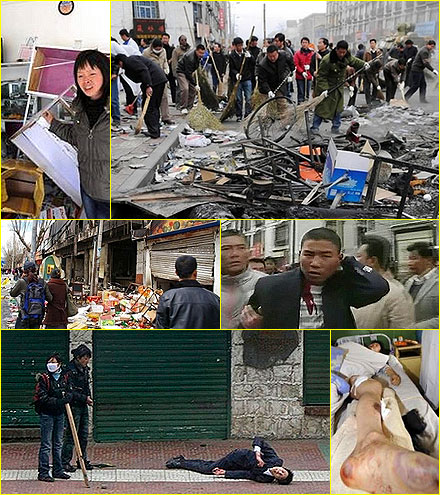
One thing that's become quite clear is that the protests in Lhasa devolved quickly into an all-out riot — complete with lynchings — while in other places monks seem to have marched more or less peacefully. (At least according to what we know now, which is very little.) Even if half the stuff written in the Chinese media about what Tibetans in Lhasa did to local Han and Hui residents is true, I'm gonna have to step out on a limb here and say that it's just plain wrong.
From Xinhua:
In the Lhasa unrest, rioters sliced off people's ears, gored children, clubbed young Tibetans into coma and tried to block nurses from saving an injured 5-year-old.
Tibet regional chairman Qiangba Puncog told a news briefing in Beijing on Monday that 13 innocent civilians were burned or stabbed to death in Friday's riots.
Puncog said that the mobs' actions were extremely brutal. "In one incident, they poured gasoline onto an innocent person and burned the person to death. In another, they knocked over a police officer, and then knifed a fist-size piece of flesh out of the officer's buttocks."
From China Daily:
Some rioters wielded iron rods, wooden sticks and long knives, randomly assaulting passersby, sparing neither women nor children....
Tubdain, a local resident, said he saw a girl in red-clothing who appeared to be an ethnic Han chased and clubbed by six people on the Dosenge Road in the downtown area. "The mobs stoned her head and batted her knees with wooden clubs," said the 50-something Tubdain.
"Blood trickled down her face. She stumbled to the ground, crying and begging the rioters to let her go," he said. "They seemed like a bunch of insane people, growling, stabbing, smashing and burning. It was so hard to believe what I saw."
Jin Hong, a clerk with the Bank of China outlet on Lhasa's Beijing East Road, suffered a broken pelvis after jumping from the second-floor of the building while trying to protect a cash box.
"About 60 rioters, all young men and women, attacked the bank with rocks and axes and set fire to the building on Friday afternoon."
"I hid in the toilet with three colleagues, but the mobs thronged against the toilet door. I had to jump out of the window," she said.
Now, I know many of you will argue that the explosive anger shown in the riots is a result of years of boneheaded Chinese policy in Tibet and an extremely repressive environment. You're right. And some of you will say, well, there are probably 100 or more Tibetans dead. Maybe. But does that give people the right to cut chunks out of other people's rear ends? Aren't Tibetans supposed to take the high road, like Gandhi, Dr. Martin Luther King Jr., and... err, Jesus? (How did these three ever come to form a trio in my mind? I'm a Jew for Christ's sake!)
Yes, the Chinese have pushed the Tibetan people for years and years, and something's gotta give. Nevertheless, the shameful actions of the rioters in Lhasa targeting innocent civilians last week were wrong, plain and simple.
Tibetan religious leaders, specialists condemn violence in Lhasa
17 March 2008
Xinhua News Agency
(c) Copyright 2008 Xinhua News Agency
LHASA, March 17 (Xinhua) -- Tibetologists in Lhasa have condemned the violence that rocked the Buddhist holy city and killed 13 innocent people Friday.
Cering Doje, deputy director of the religion research institute of the Tibetan Academy of Social Sciences (TASS), said that he questioned the Dalai Lama's humanity and mercy.
"Religion advocates care and mercy, but the reckless rioters attacked hospitals and child-entertainment centers," Doje said, "They seemed to have lost basic humanity, and there was no mercy at all."
Other Tibetologists said that they were outraged by the Dalai Lama's silence in condemning the riot.
In the Lhasa unrest, rioters sliced off people's ears, gored children, clubbed young Tibetans into coma and tried to block nurses from saving an injured 5-year-old.
Tibet regional chairman Qiangba Puncog told a news briefing in Beijing on Monday that 13 innocent civilians were burned or stabbed to death in Friday's riots.
Puncog said that the mobs' actions were extremely brutal. "In one incident, they poured gasoline onto an innocent person and burned the person to death. In another, they knocked over a police officer, and then knifed a fist-size piece of flesh out of the officer's buttocks."
On Saturday, the Dalai Lama charged that Tibet was being ruled by terror, which Tibetan officials rejected as "downright nonsense".
Basang Wangdu, another Tibetologist and a council member of the International Society of Tibetology, said that people could see from Friday's riots that the Dalai Lama had not ceased his secessionist activity but added that these attempts "will not succeed."
While condemning the riots, others called for solidarity among all ethnic groups at what they said was a critical time.
"Tibetans and Hans share a common cultural background. We have links that cannot be severed," said Cering Gyaibo, the head of TASS' religion research institute.
"At this critical time, we need to cherish ethnic solidarity and muster courage to protect territorial integrity and ethnic harmony," he said.
The religious researchers' comments came as the latest condemnations against the violence. The 11th Panchen Lama, Gyaincain Norbu, said on Sunday that the violence in Lhasa ran counter to Buddhism tenets.
Living Buddhas in Tibet also voiced their opposition. Ngawang Daindzin, a living Buddha, said that "the rioters who wore cassocks were no real monks at all. What they did is completely against Buddhism codes."
Local Tibetans, who survived the violence, said they were deeply hurt. A retired worker, Cering Yangzom, said that "it had been repeatedly proven that the Dalai Lama and his followers could not separate Tibet from China, and such savage acts only hurt the feelings of many Tibetans and only revealed a true picture of the Dalai Lama."
Fears and tears in holy plateau city
China Daily
Updated: 2008-03-17 06:36
LHASA - Dense smoke blanketed the sky as burning cars emitted an irritating smell amid the wailing of bloodshed.
A Tibetan teacher said she couldn't believe her eyes.
"I've never seen such cruelty before. How can anyone do something like this?" asked Zhayung, who works at the No 1 primary school in Lhasa. Her voice was still shaky and her complexion tinged with fear and sheer shock.
The school she worked at was among a range of targets damaged by saboteurs in the Tibetan capital on Friday afternoon.
Vandals carrying backpacks filled with stones and bottles of inflammable liquids smashed windows, set fire to vehicles, shops and restaurants along their destructive path.
Some rioters wielded iron rods, wooden sticks and long knives, randomly assaulting passersby, sparing neither women nor children.
"Classes were cancelled," Zhayung said. "I managed to escape from the school and hide in the building across the street, but some of my colleagues were stranded in the school for the whole night until police came to their rescue."
For many Lhasa residents such as Zhayung, March 14 stopped being just another Friday - it was a day when the capital was left in chaos after an outburst of beatings, vandalism, looting and burning, which officials say was "masterminded by the Dalai clique".
The Tibet regional government said on Saturday at least 10 people were killed, including several from burns and gunshot wounds. Police managed to rescue more than 580 people, including three Japanese tourists, from attacks.
Sources told Xinhua that rioters had ransacked at least 100 shops. The four-storey Landun shopping mall in the old city center, which sold children clothes, was engulfed in flames sparked by the horde.
Its owner, Ye Danping, and her 20 Tibetan employees were lucky to survive after scrambling onto the roof of the building.
Nightmares
As tensions began to ease on Saturday, residents in the traditionally tranquil plateau city recalled the nightmares they went through.
Rawang, a Tibetan clothes vendor in downtown Lhasa, sighed at the dreary scene, once the site of bustling commerce. "It was once a shopping haven, but now it's all deserted, like a hell." His shop was burnt to the ground. "Losses were grave. These people were crazy," he said.
Tubdain, a local resident, said he saw a girl in red-clothing who appeared to be an ethnic Han chased and clubbed by six people on the Dosenge Road in the downtown area. "The mobs stoned her head and batted her knees with wooden clubs," said the 50-something Tubdain.
"Blood trickled down her face. She stumbled to the ground, crying and begging the rioters to let her go," he said. "They seemed like a bunch of insane people, growling, stabbing, smashing and burning. It was so hard to believe what I saw."
Jin Hong, a clerk with the Bank of China outlet on Lhasa's Beijing East Road, suffered a broken pelvis after jumping from the second-floor of the building while trying to protect a cash box.
"About 60 rioters, all young men and women, attacked the bank with rocks and axes and set fire to the building on Friday afternoon.
"I hid in the toilet with three colleagues, but the mobs thronged against the toilet door. I had to jump out of the window," she said.
Saved by Tibetan folks
In response the regional government imposed traffic bans and increased the police presence to ensure social security.
For the many ethnic Hans who were lucky enough to survive the disaster, they said it was the Tibetan folks who saved them.
Sun Pingjiang, an ethnic Han and owner of a Titan-styled accessories store near the Ramogia monastery, said he owed his life to an elderly Tibetan woman who saved him from bleeding to death.
"I was attacked by more than 30 people about my age when I was running from my store to my friend's. The mobs beat and stabbed me," said the 26-year-old.
"When I finally managed to run away, I stumbled along and knocked at every door I could for help. A Tibetan woman in a chessboard game room came to my rescue," he said. "She took me in and called the emergency number 120 when the streets calmed down," he said.
Sun is being treated for leg and back injuries at the General Hospital of Tibet Military Command.
During Friday's riot, many local Tibetans came to the help of ethnic Hans.
Ma Ruixia, a Han woman who owns clothes and souvenir shops on Barkor Street in the downtown, said her establishments were attacked twice by the mob. She survived with the help of her Tibetan landlord and neighbors.
"Around 2 pm, Friday, I heard people shouting in the yard that rioters were coming and we needed to take shelter," she recalled.
"My Tibetan neighbors faced up to the mob and pleaded with them not to ravage my stores," she said. "I really didn't know what was going on out there. It was horrible."
Ye, who came to Lhasa 15 years ago from coastal Zhejiang province, said she would stay on in Lhasa, because she took this place as her second hometown.
"I wish the government would properly handle the incident and make Lhasa a safe place again," she said.

posted March 18, 2008 at 07:42 AM unofficial Xinjiang time | HaoHao This!